QW7M+26M alcaide / X3JW+RR carboneras
QW7M+26M alcaide / X3JW+RR carboneras is an artist’s publication examining two sites in the province of Almería identified only by their Plus Codes. Through drawings, photographs and an extended essay, the work considers the relationships between vernacular water infrastructure, landscape, architecture and the sculptural practice of André Bloc. Originally produced as an artist’s book, it is presented here in its complete form…
*a downloadable PDF version is available at the bottom of this page.
QW7M+26M alcaide / X3JW+RR carboneras
NOTE:
The codes on the cover of this book are plus codes — an open location reference system that encodes precise geographic coordinates as a short string of characters. Each code identifies a specific fourteen by fourteen metre square on the earth's surface. They were developed as an addressing system for places that have no conventional address: rural sites, marginal landscapes, islands of abandonment, locations that maps have named inadequately or not at all.
The two codes on the cover locate the two sites this book concerns itself with — a water catchment system on a dry mountain above Vélez Blanco in the north of the Almerian province, and a house on the desert coast at Carboneras in the south. Neither site has a street address that would find it with any precision. Their plus codes do.
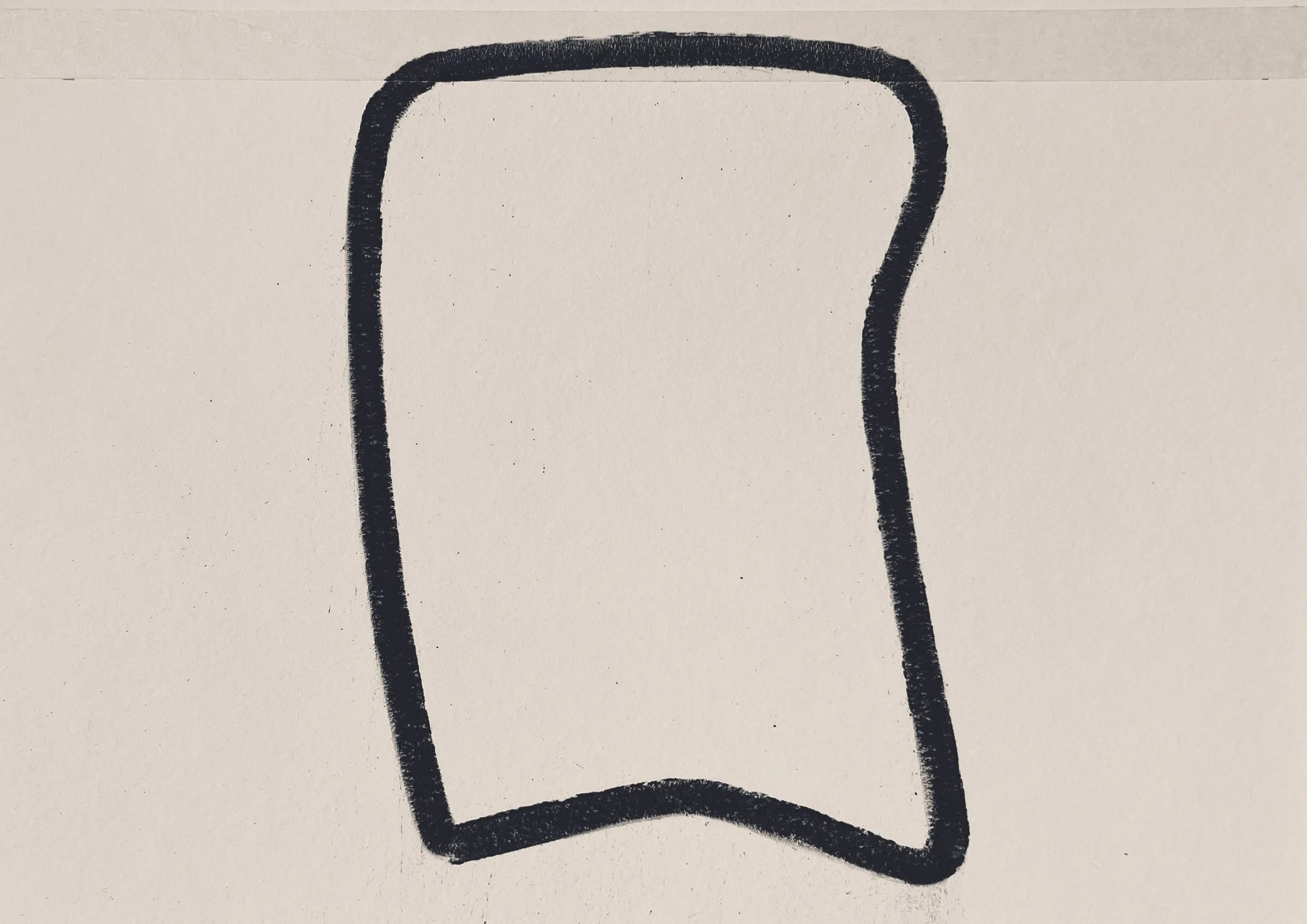
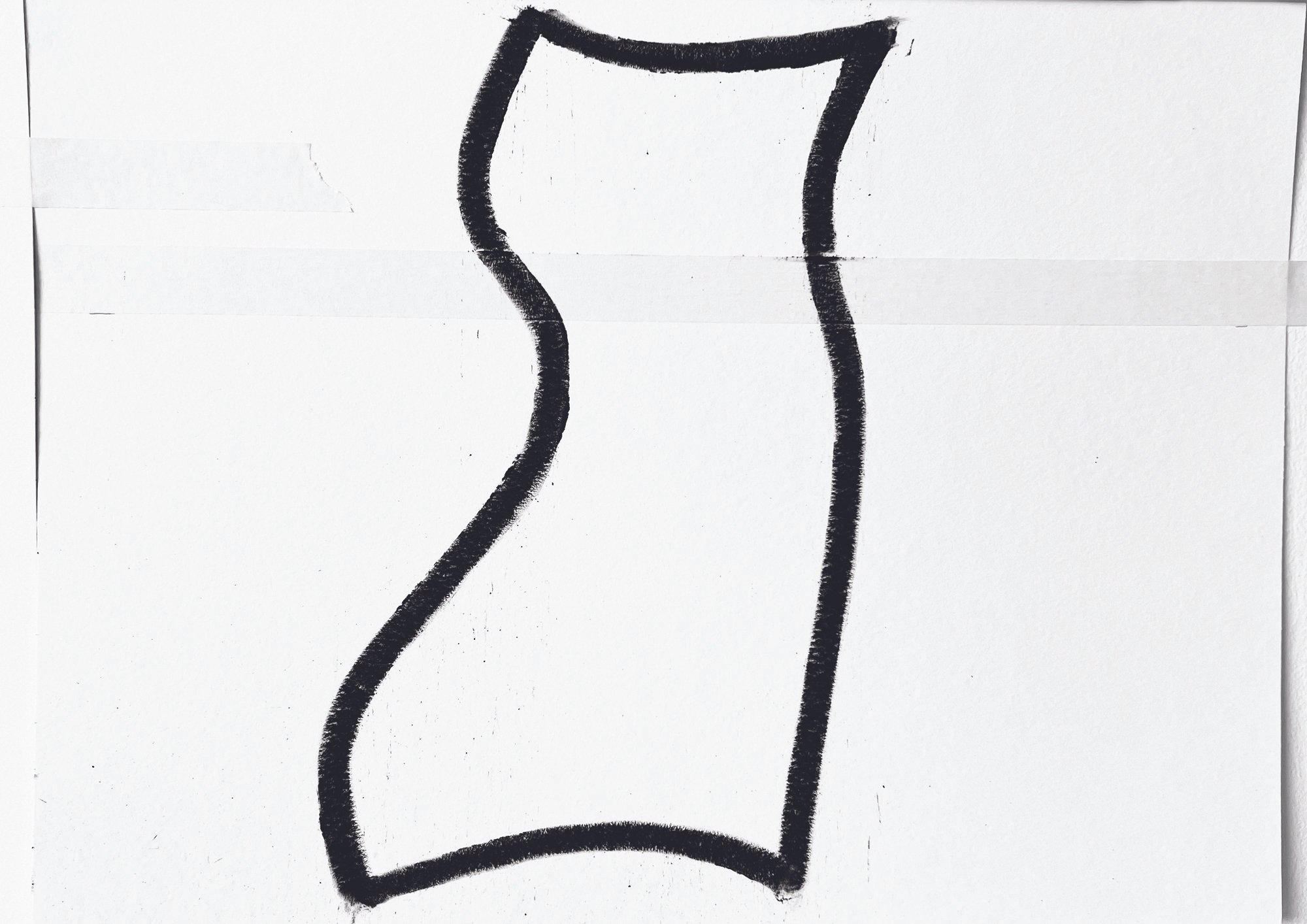
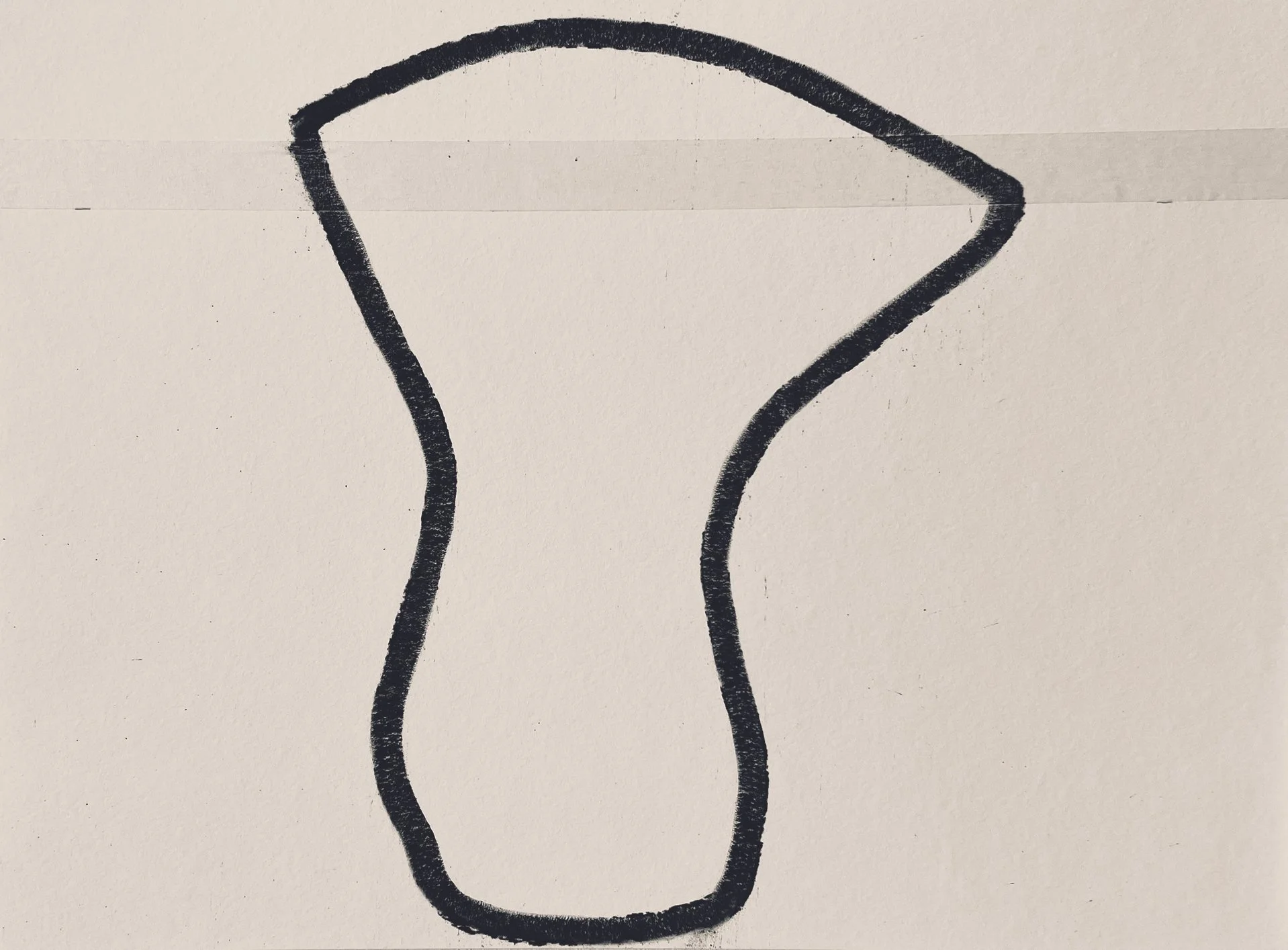
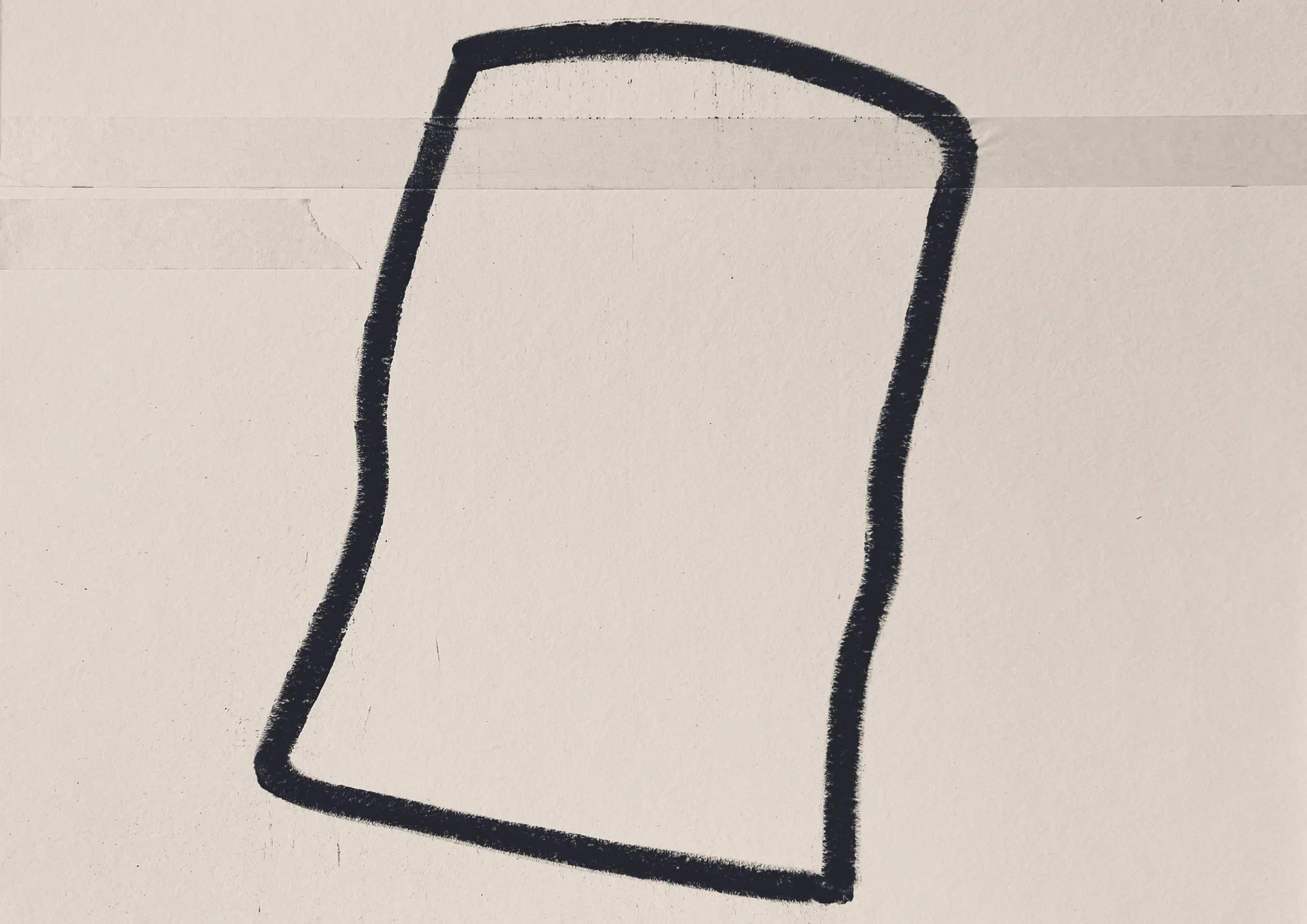
The drawings in this book carry the same notation. Each is titled with the plus code of the precise location at which it was made — not a name, not a description, not an interpretation. A coordinate. The drawing is located rather than named, as the sites themselves are located rather than named on the cover. The plus code is the only title these drawings need or claim.
Plus codes can be entered directly into any mapping application to locate a site precisely. Enter the code and the place name together — for example, QW7M+26M Alcaide — and the map will find it.
There is a category of form that belongs to neither the maker nor the material alone. It emerges in the charged and resistant space between them, in the moment where intention meets what will not yield, where the body pressing upon the ground discovers that the ground presses back with everything it is: its geology, its gradient, its long indifference to human need. In that encounter, something is produced that neither party intended and neither could have predicted. Call it an inevitable aesthetic — the form that had to be, given these hands, this earth, this sky withholding its rain.
The Andalucían province of Almería is a landscape that does not forgive inattention. Its light is not the soft suffusion of the northern Mediterranean but something harder and more interrogative — a light that finds the thing and holds it, that bleaches intention from the surface of objects and leaves only their structure. It is a landscape that has always compelled a particular kind of making: not the making of abundance, not form generated by surplus and choice, but form wrested from scarcity, from the calcareous resistance of a ground that offers almost nothing freely. What gets built here has always reflected those conditions — not imposed solutions, but responses arrived at incrementally, under duress, over generations of patient, bodily negotiation with terrain.
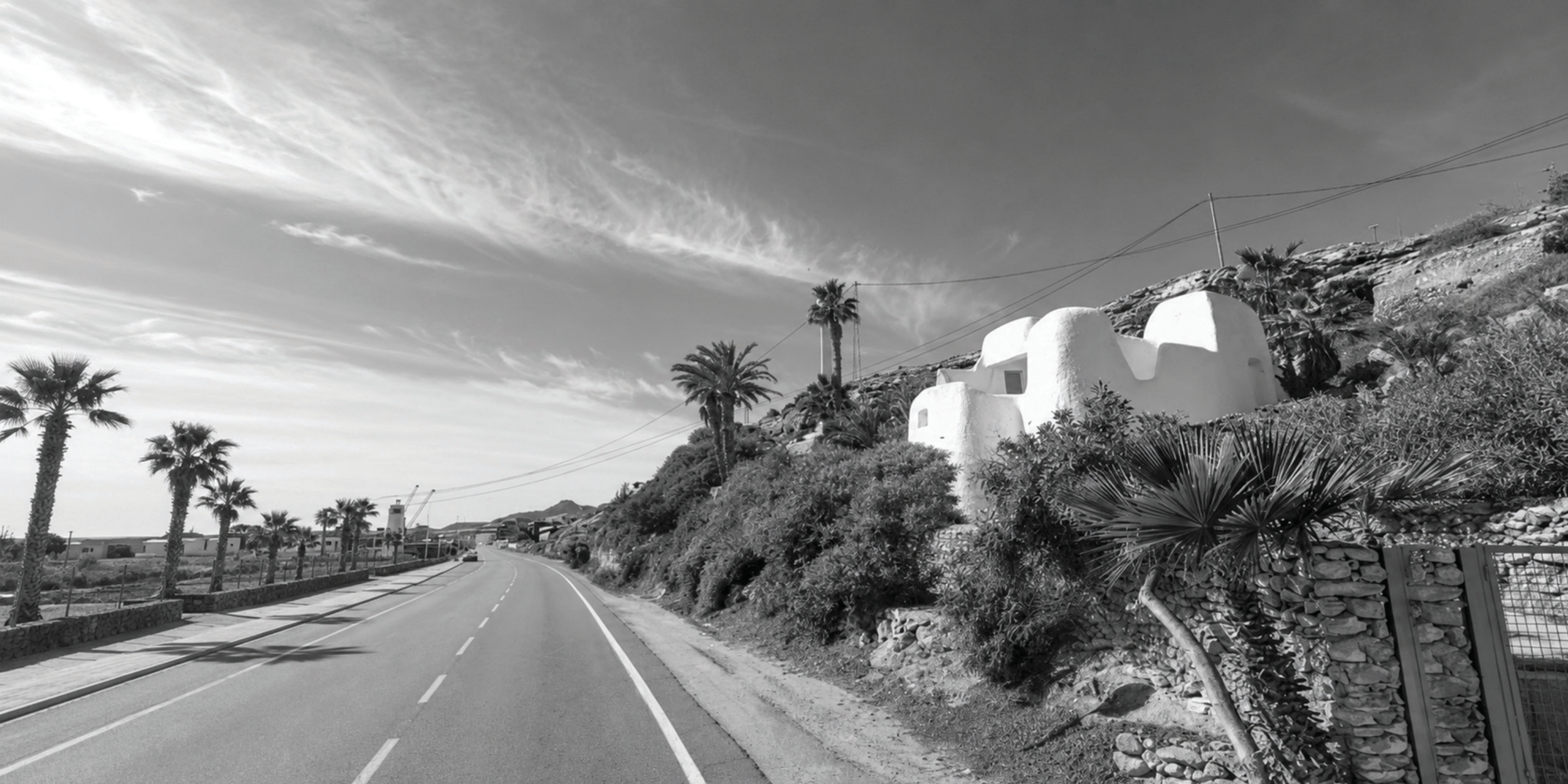
Two objects concern us here. They are separated by two hundred kilometres — one in the north of Almería, the other in the south — and by half a century of history. One is an abandoned and obsolete water catchment system — a cañada y boquera — carved into the dry mountain above Vélez Blanco, probably in the eighteenth century, by farmers whose names we do not know and whose intelligence we have consistently underestimated. The other is a house — Casa El Laberinto, locals called it — built at Carboneras in 1962 by the French sculptor and architect André Bloc, homme de synthèse*: engineer, editor, sculptor, architect “with the support of architect Claude Parent”. Call it a period signature, a utopian impulse — the belief that a new spatial experience could produce a new kind of human consciousness. Carboneras, on the economic margins of Francoist Spain, was exactly the kind of place such experiments required. Both the labrador de tierra* in the north of the province and the homme de synthèse in the south produced, unknowingly, cognate forms — form that neither the history of art nor agriculture has thought to consider.
“To consider these forms at all - specifically the cañada y boquera - requires, in the first instance, that they be made visible. But visibility here is not a neutral act — it is also an aesthetic one. I have returned to this landscape repeatedly, on foot, over twenty years, drawing what I find — not as illustration but as a mode of inquiry, a way of knowing the ground that no other method makes available. The drawing that recovers a deteriorated system from collapsed dry stone and eroded earthwork is not a survey document. It is an act of attention that is simultaneously archaeological and artistic — the two modes inseparable, each making the other possible. What the eye trained on landscape finds, the hand trained on drawing recovers. And in that recovery something else occurs: the form, freed from the debris of its own deterioration, reveals itself as something more than infrastructure. It reveals itself as what it always was — a spatial proposition, an aesthetic consequence of human intelligence meeting resistant ground. To draw it is to make that proposition legible again. That is why these drawings are in this book, and why they belong here alongside, and in conversation with, the forms of André Bloc.
This is why I draw the subject — on foot, in the field, returning again and again until the system declares itself. The cañada y boquera is a logic embedded in terrain, readable only through the slow, patient act of walking every metre of it, learning to see the wall in the collapsed dry stone and the earthwork in the erosion. A drone photograph would show scrub and limestone. A survey would show contours. Neither would show this: the intelligence of a system, the grammar of intention that persists in a deteriorated landscape long after the hands that made it have gone. Reduction is the drawing’s purpose — vegetation, the picturesque accident of ruin, the collapsed dry stone lichen-crusted and half returned to the mountain that made it, all of it falls away. What remains is the decision, rendered as a single continuous line on paper. The line is where a labrador de tierra, two or maybe three centuries ago, determined where water would go. That determination is still there, in the ground. It was waiting to be seen.”
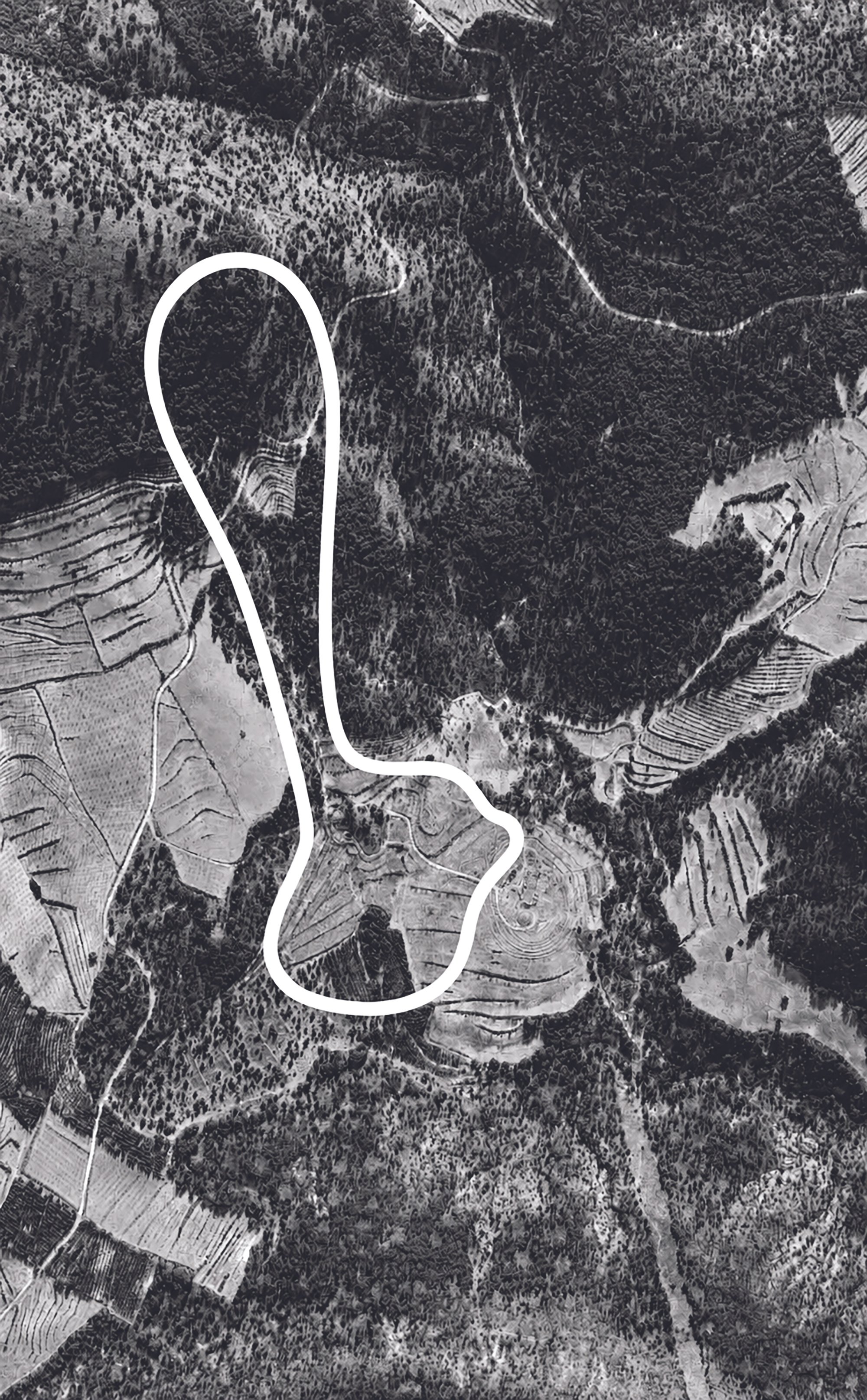
1) cañada y boquera
location: Joya: arte + ecología / AiR . Cortijada Los Gázquez . Parqué Natural Sierra María - Los Vélez . Vélez Blanco . Almería . Andalucía . España . QW7M+26M Alcaide
altitude: approx. 1000m
area: approx 20 hectares
classification: KöppenGeiger BSk* - cold semi arid changing to BWh - hot desert. Average temperatures 13.1º C average rainfall 352mm
biome:
Mediterranean steppe* / chaparral* / Iberian conifer forest / semi-deciduous forest / sclerophyllous vegetation*
Forests of holm oak (Quercus rotundifolia) were once predominant in plains and valleys with deep alluvial soil. Over centuries these forests have been converted to agriculture, pasture or maquis* scrubland, a dense thicket of tall woody shrubs and low trees, mixed with low shrubs, herbs, and grasses.
In the heart of a natural park of sedimentary limestone, marl, and gypsum-derived soils we are home to a mosaic landscape, with extensive mixed forest of Aleppo pine (Pinus halepensis) and holly oak (Quercus coccifera), open juniper woodlands of Juniperus thurifera and Juniperus phoenicea, steppe grasslands with Stipa tenacissima and Lygeum spartum, and low shrublands with Artemisia herba-alba, Thymelaea hirsuta, Ononis tridentata, Helianthemum squamatum, and Thymus mastigophorus.
history:
This was a subsistence farm, a small holding, mixed almond / cereal / chickens / rabbits and pigs + wild game. Additionally it benefitted from a water catchment system (cañada y boquera) used principally for cordero segureño* (sheep and goat grazing) and vegetable / fruit trees.
The farm was abandoned in the late 1960s early 1970s falling into disrepair…
A Water Catchment System: Cañada y Boquera*
A water catchment system is the network of land, vegetation and infrastructure that collects, channels and stores rainfall from a defined area — directing it toward a usable source.
The system described here is divided into two zones: the upper cañada* and the lower boquera*.
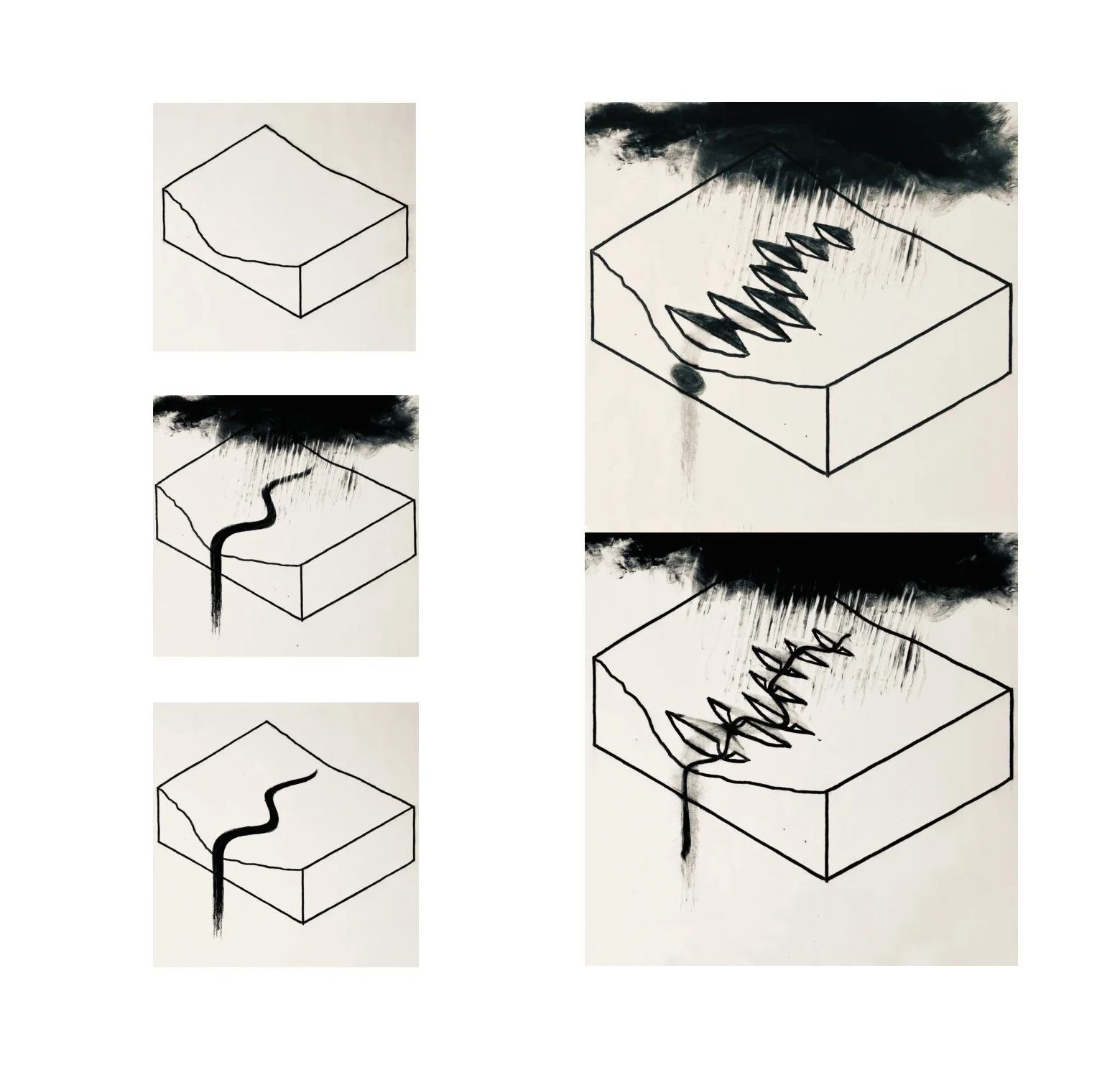
On the mountain, a large erosional gully begins its descent. Left unaltered, it would carve itself into a barranco* — a tributary feeding the broader rambla* typical of this region. At a key point along the ridge, the land transitions: steep gives way to gentle, erosion gives way to deposition. The inhabitants of this dry mountain recognised this and built a system around it.
They transformed the natural feature into a co-evolutionary landscape — engineered for subsistence farming, but coincidentally sharing its water with the flora and fauna drawing from the same source. An area rich in diversity, an insectary for beneficial insects biologically controlling pests.
In the upper erosional section, giant earth terraces were built across the gully at an opposing angle, slowing rainwater and holding it in the headwaters. This water sank into the ground, forming an underground aquifer that continued to migrate downslope under gravity. This upper section is the cañada.
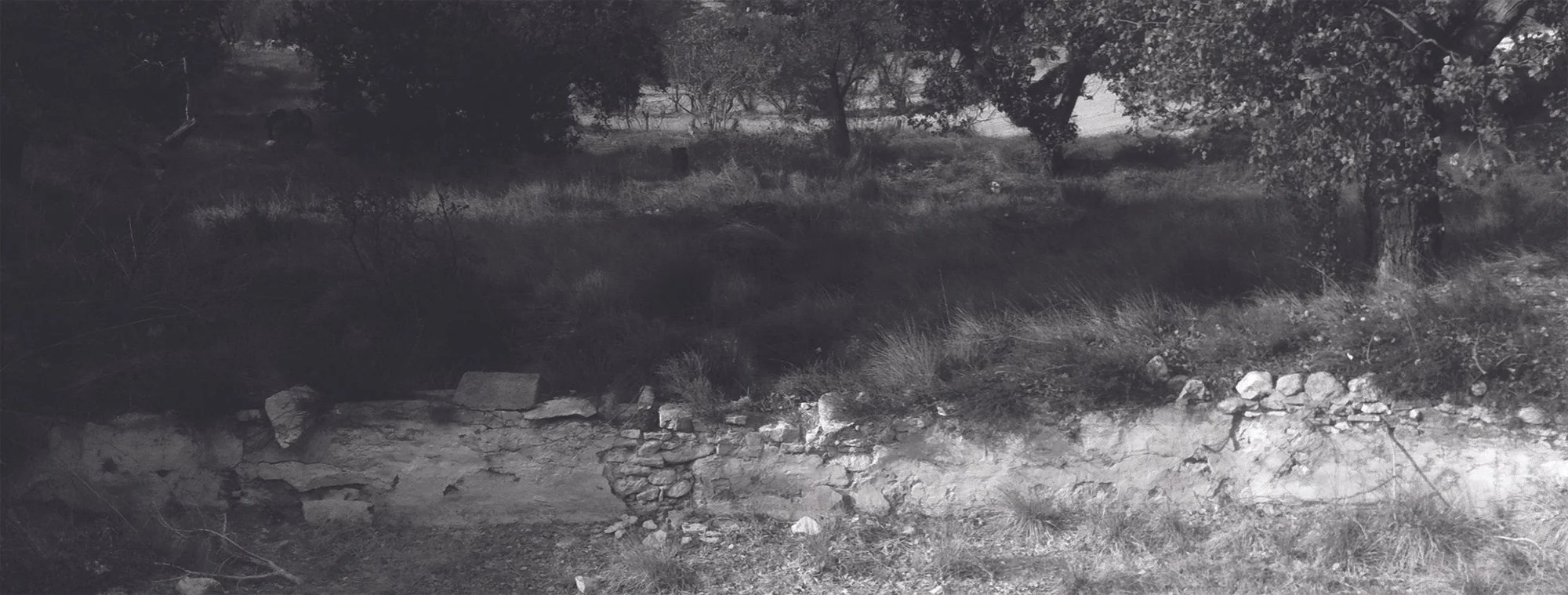
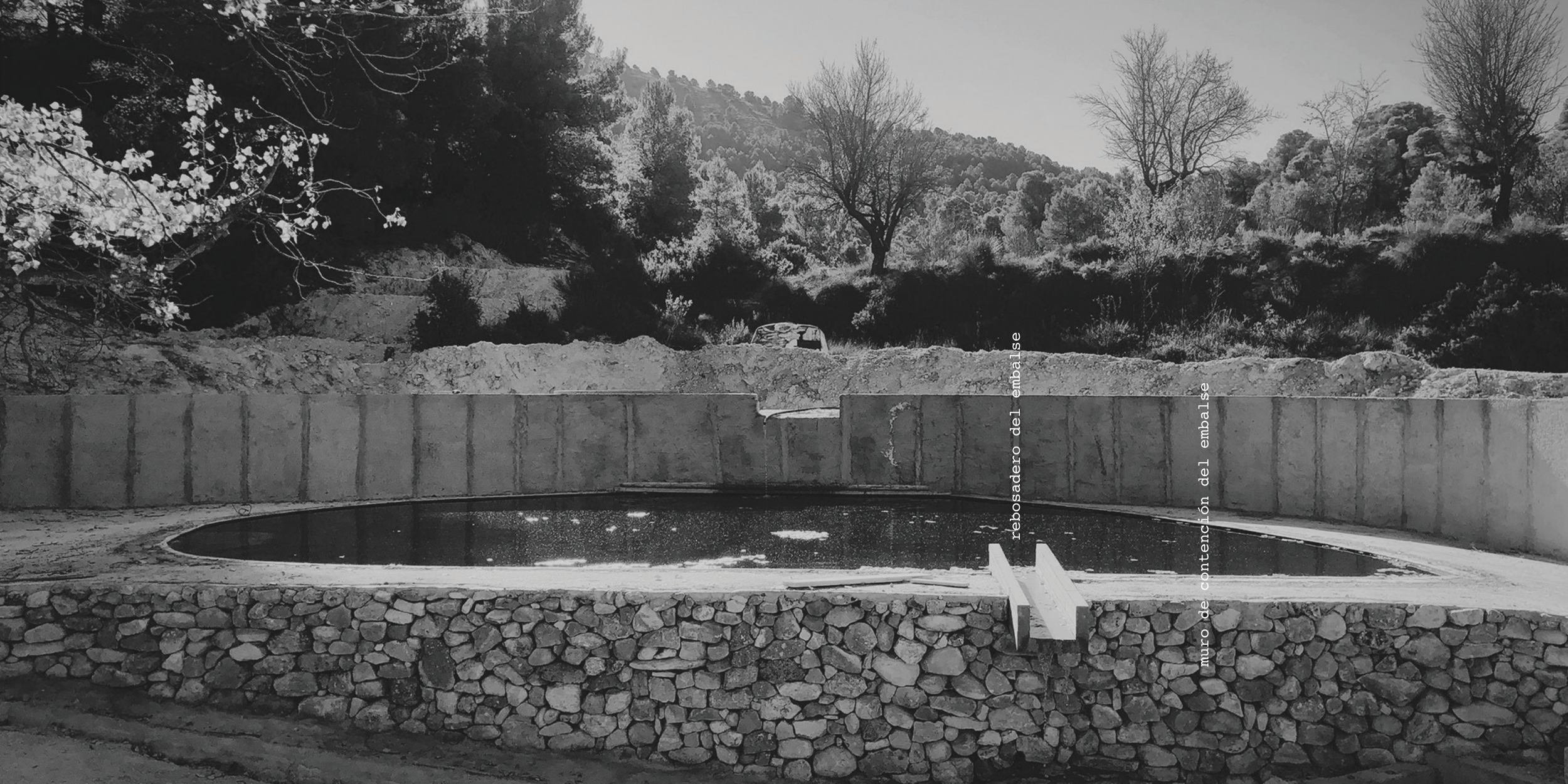
Where erosion meets deposition, a storage tank — the embalse* — was built to capture this accumulated water. Below it lies the boquera, the growing zone. From the embalse, a network of canals, acequias*, controlled by sluice gates, delivered water to where it was needed: the terrace of olive trees, the terrace of figs and pomegranates, the terrace of potatoes, peppers, tomatoes and salad crops. While the terraces are level, the acequias run off-contour, using gravity to move water through the system — transporting it hundreds of metres across nearly the entire twenty hectares. When functioning, the system could produce up to 60,000 litres of water every 24 hours.
The whole landscape is an interruption of the hydrological cycle*. Ocean evaporation becomes mountain rain, is captured in the headwaters, put to work, and returns — to the atmosphere or the water table.
The land was abandoned in the late 1960s — life here remained hard despite their ingenuity, and better opportunities lay in the industrial cities or abroad. The system is now under restoration.
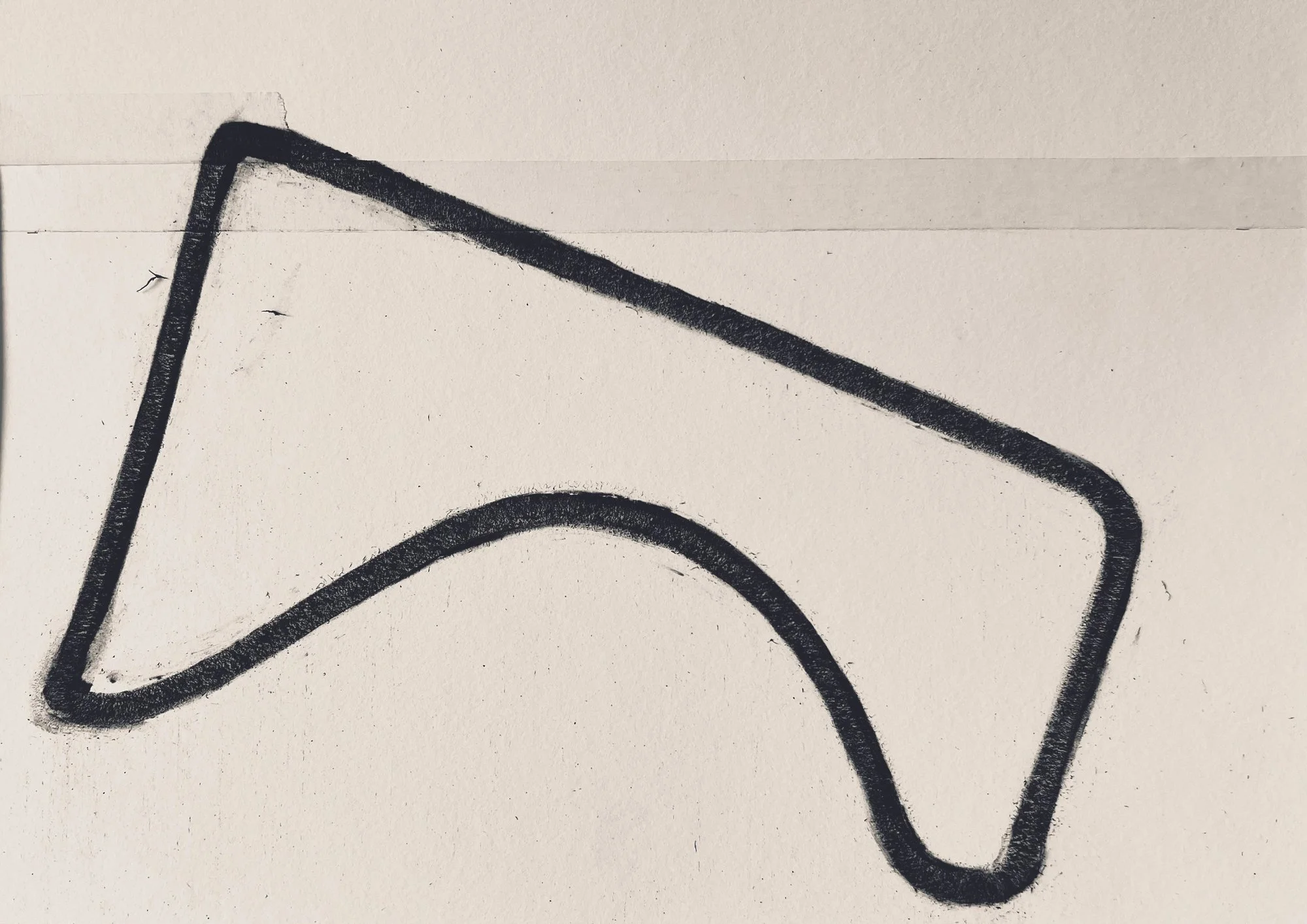
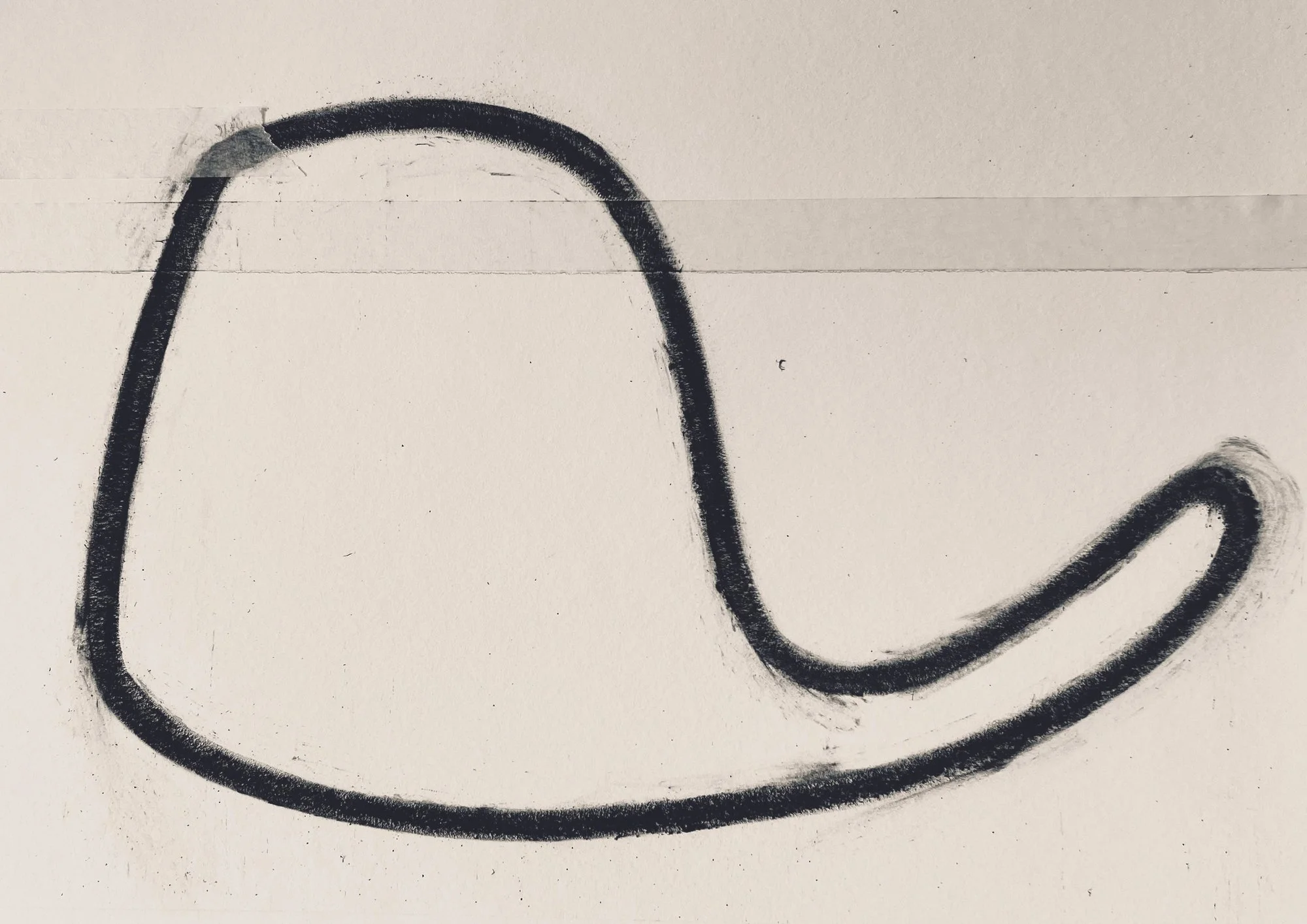
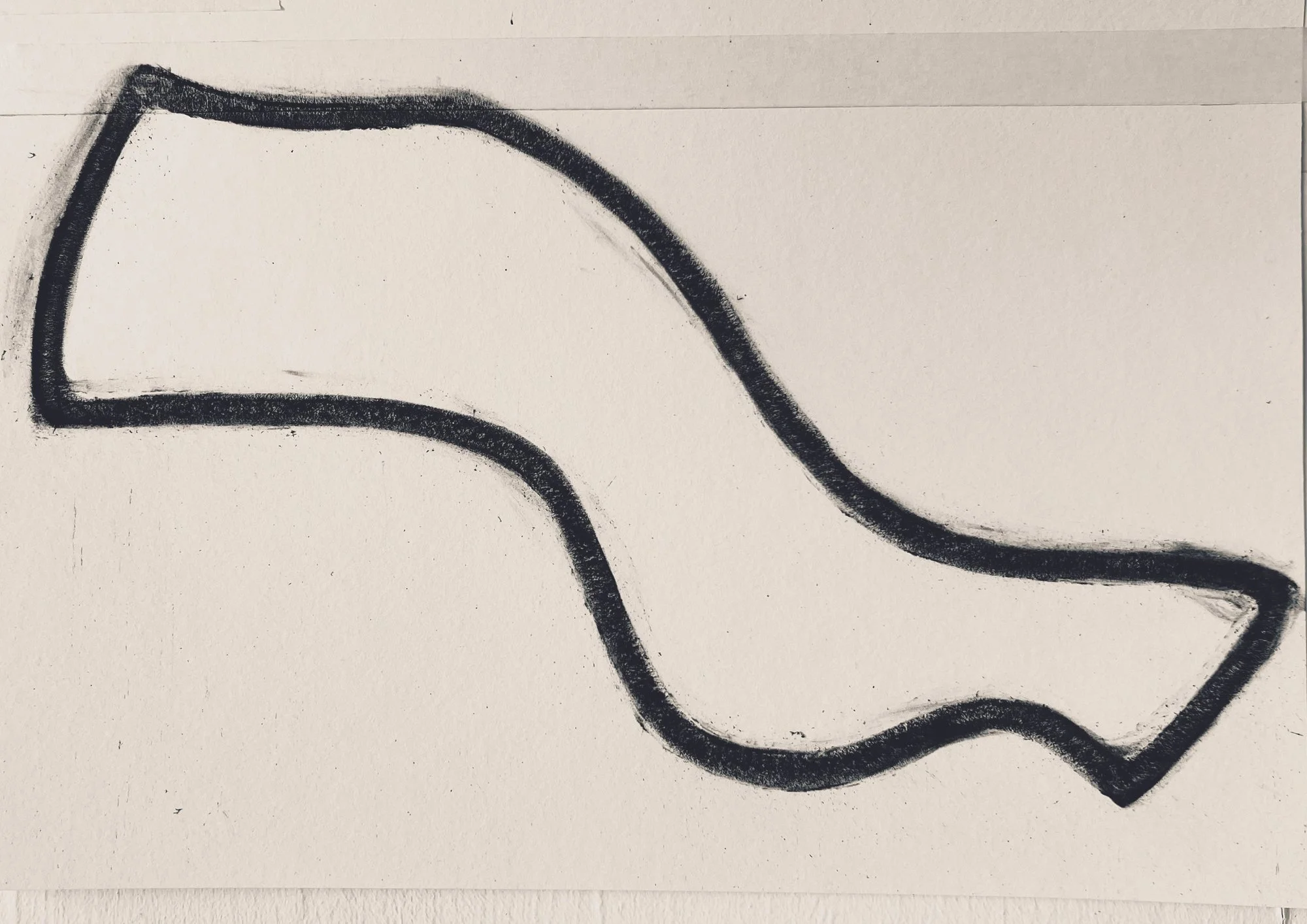
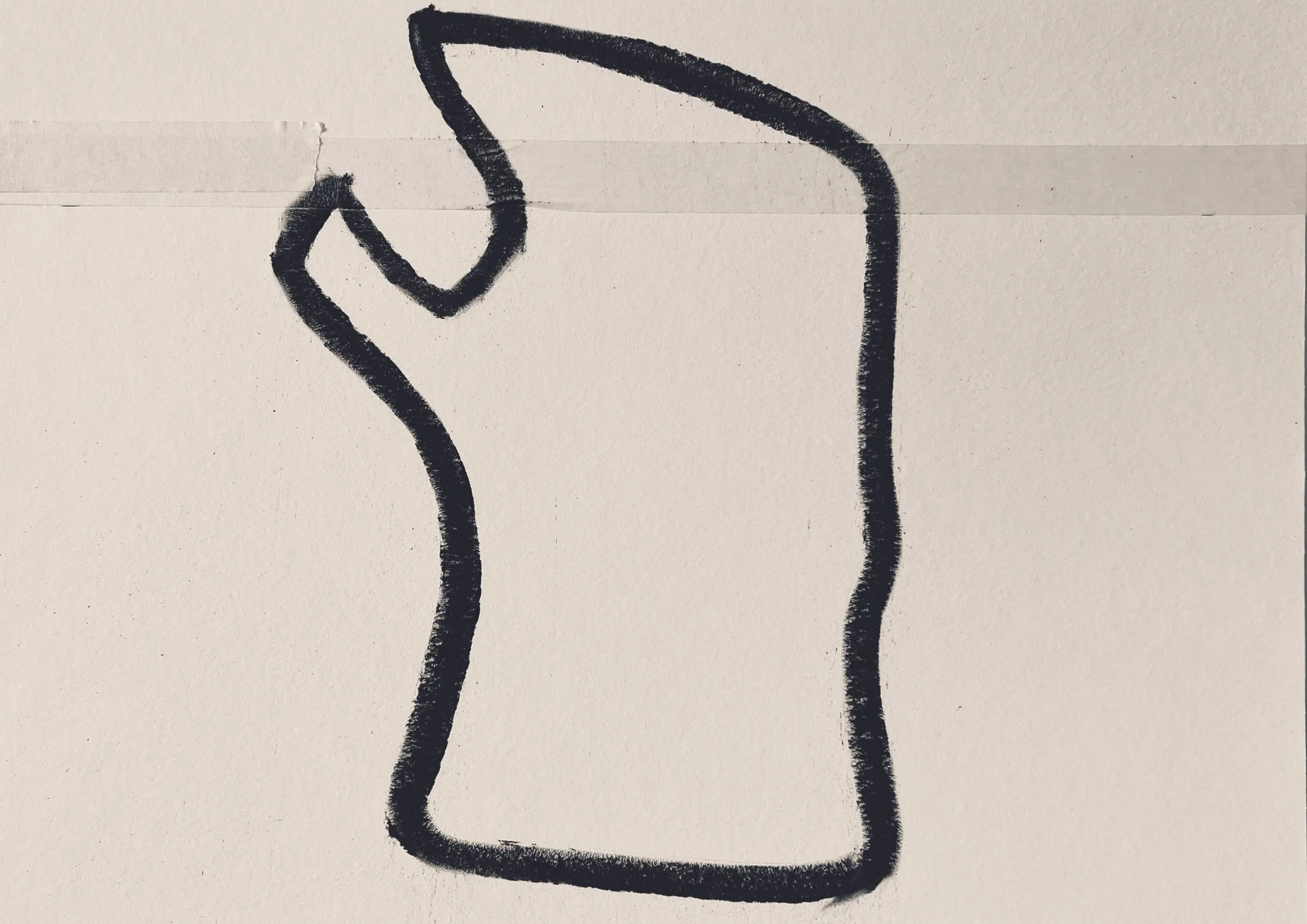
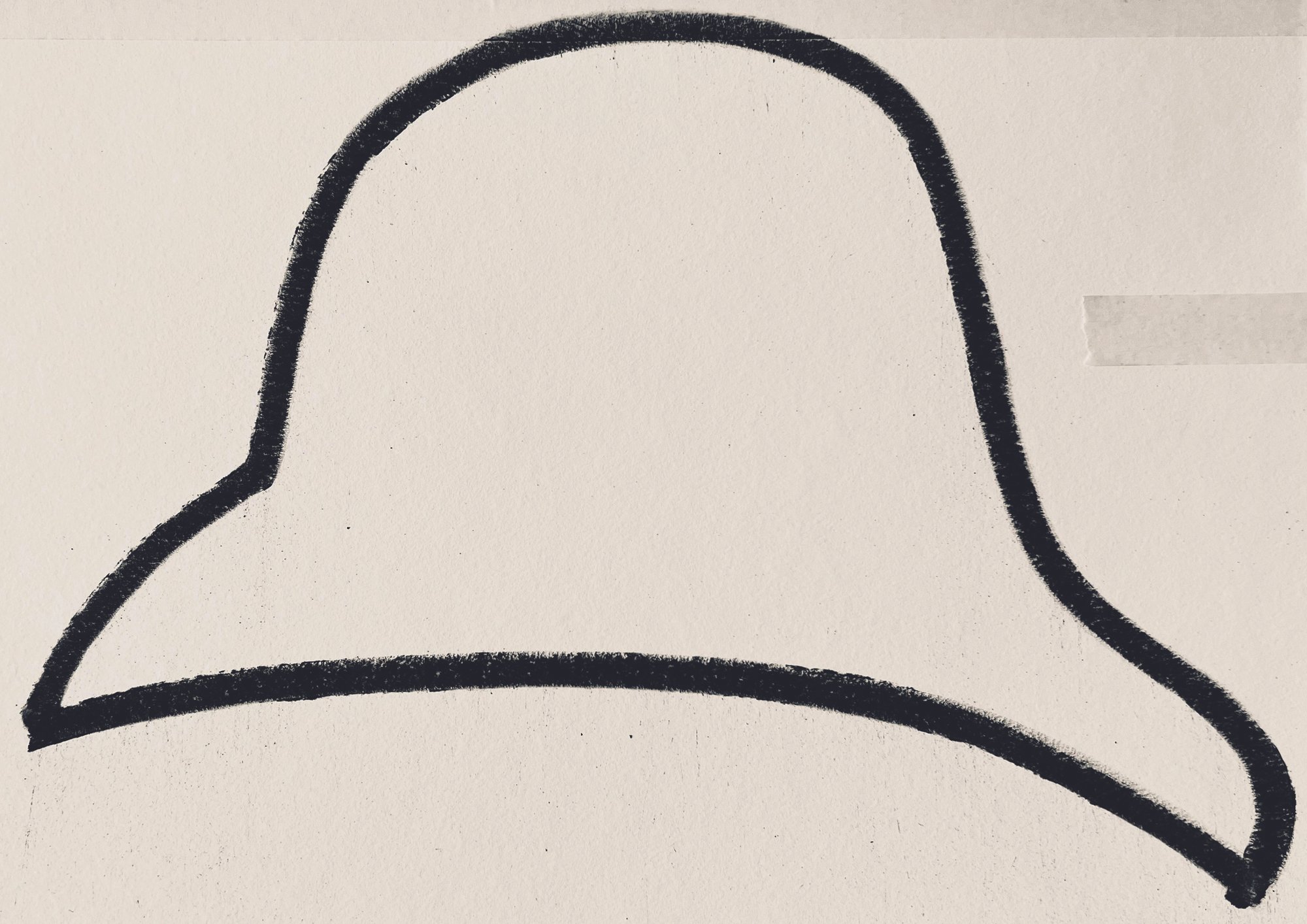
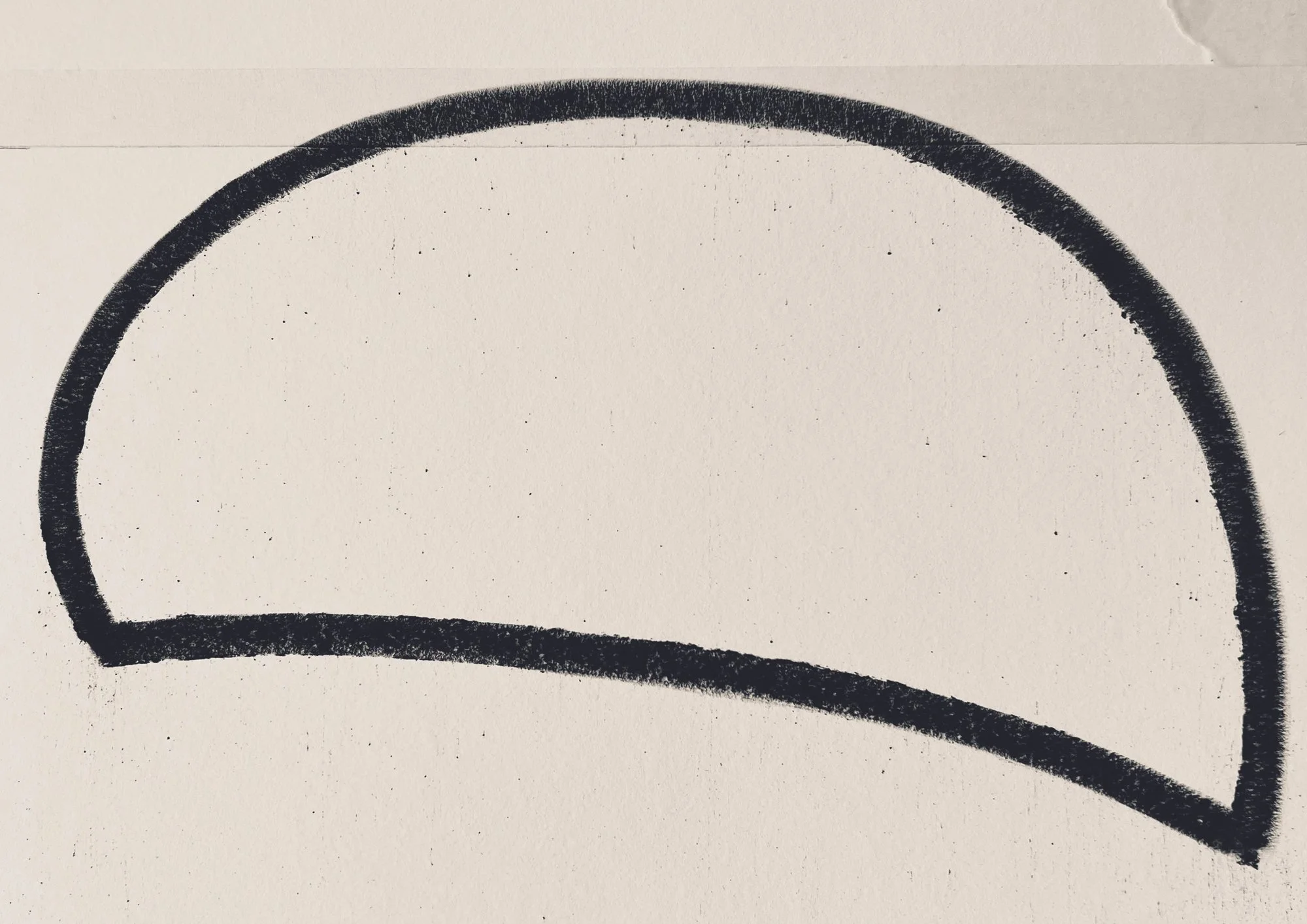
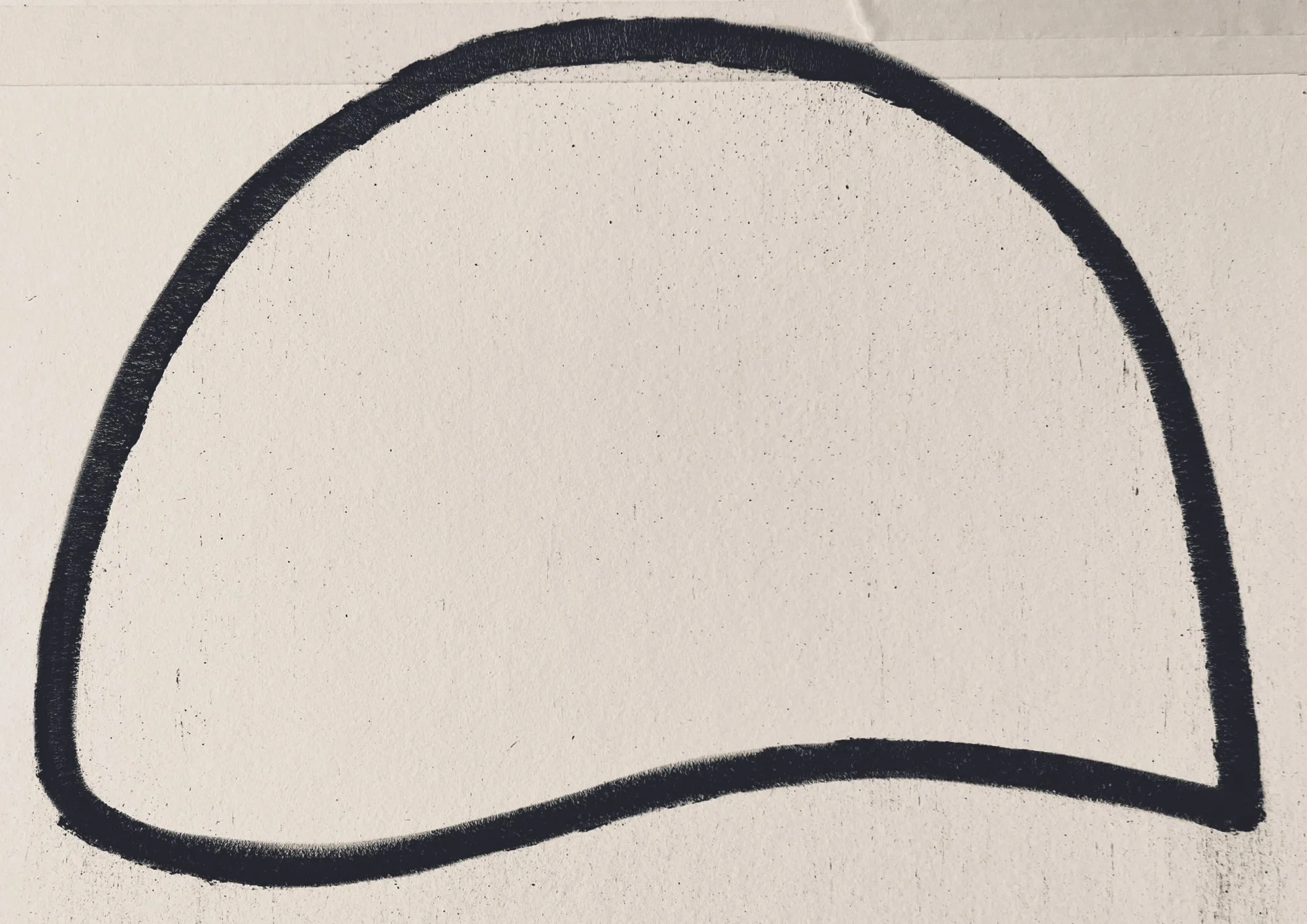
A
E
A. piedra de lavar B. piedra de lavar C. rebosadero del embalse D. piedra de lavar E. muro de contención de embalse
2) André Bloc (with Claude Parent): Casa El Laberinto
Location: Av. Faro Mesa Roldán 17T . 04140 . Carboneras . Almería . España . X3JW+RR Carboneras
Altitude: approx. 17m
Area: Approx. 208 m sq.
Classification:
Carboneras falls under the Köppen-Geiger classification BWh — a hot desert climate (B = arid, W = desert, h = hot, meaning the mean annual temperature is above 18 °C). Average rainfall 250mm.
Biome:
Hot desert / xeric shrubland — specifically the Mediterranean dry woodlands and steppe transitioning into true xeric desert scrub, part of the broader Almería desert ecosystem. Some classify this coastal strip as the only true hot desert biome on continental European soil.
Vegetation — Extremely sparse and highly adapted to aridity. Dominant species include esparto grass (Stipa tenacissima), dwarf fan palm (Chamaerops humilis, Europe's only native palm), various succulent-leaved shrubs like Ziziphus lotus, sea purslane, and a scattering of Lycium intricatum and Salsola species. True cacti are absent naturally but have naturalised in places. Much of the ground between plants is bare, stony or sandy.
Soils — Thin, skeletal, and saline in places. The Cabo de Gata area sits on volcanic geology — one of the few points of volcanic origin on the Iberian Peninsula — giving the soils an unusual geochemical character quite unlike the limestone-derived soils of most of Andalucía.
History:
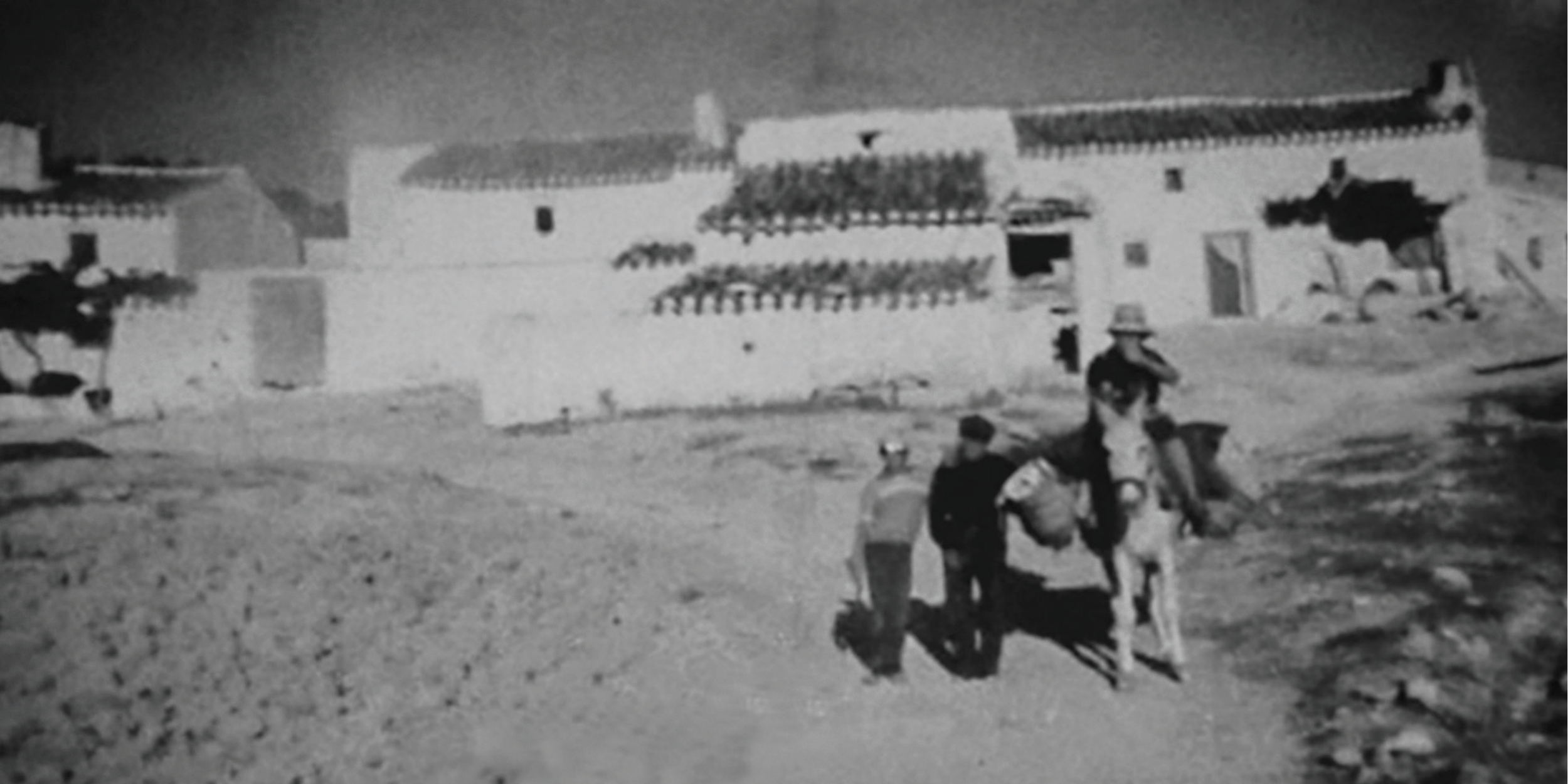
The name Carboneras is almost certainly derived from the production of carbón vegetal (charcoal). Through the 19th century the town was shaped by esparto grass cultivation and fishing — modest industries that kept it small and isolated, and isolation remained its defining characteristic well into the 20th century. It was precisely this quality that attracted a wave of French and international artists and intellectuals in the 1950s and 60s, among them André Bloc.
The 1980s brought dramatic change: a commercial port, a cement factory, a thermal power station, and aquaculture facilities transformed the economic base almost overnight, while tourism developed in parallel following the declaration of the Cabo de Gata–Níjar Natural Park in 1988, which today protects around 80% of the municipality. The result is a town of roughly 7,500 people — an unusual combination of industrial activity, fishing heritage, and nature tourism rarely found on the coast of Andalucía.
D
C
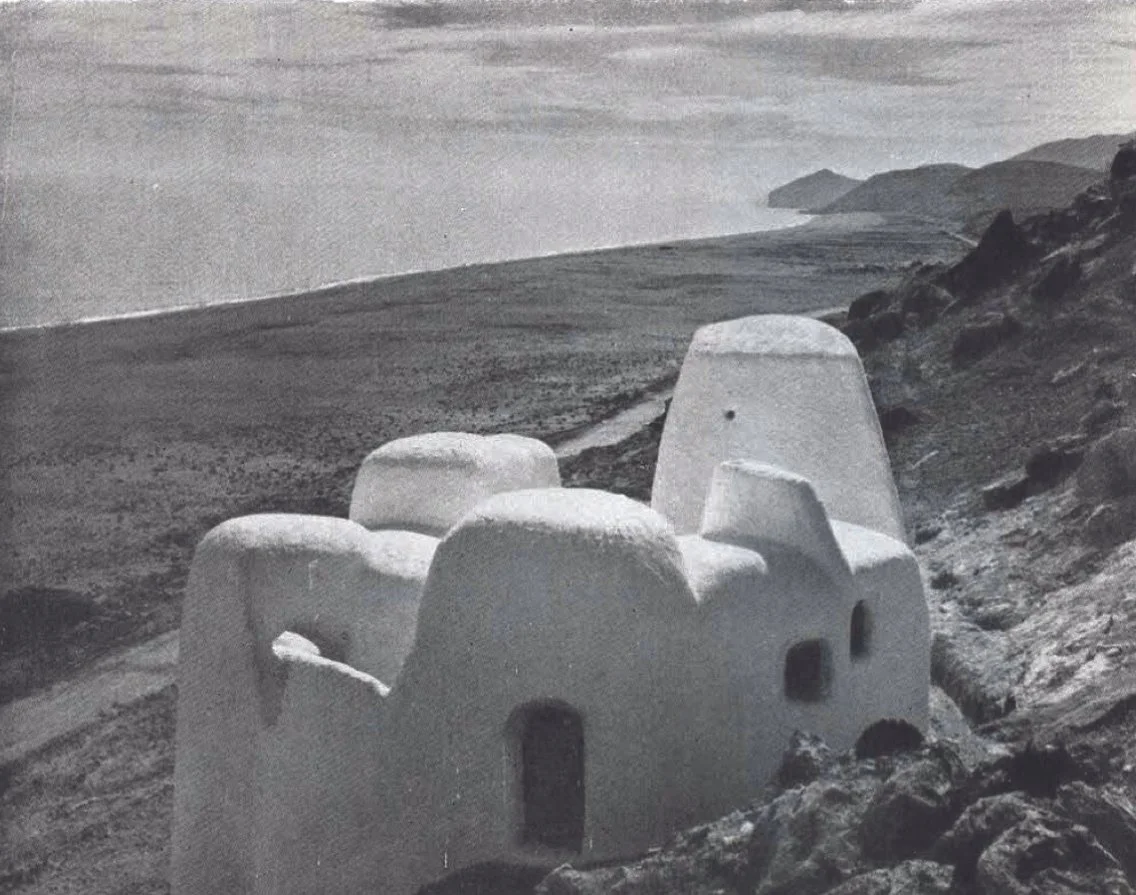
Casa El Laberinto
The construction of Casa El Laberinto was as unconventional as its form, and represents a fascinating negotiation between artistic ambition and physical necessity.
Starting point — no drawings
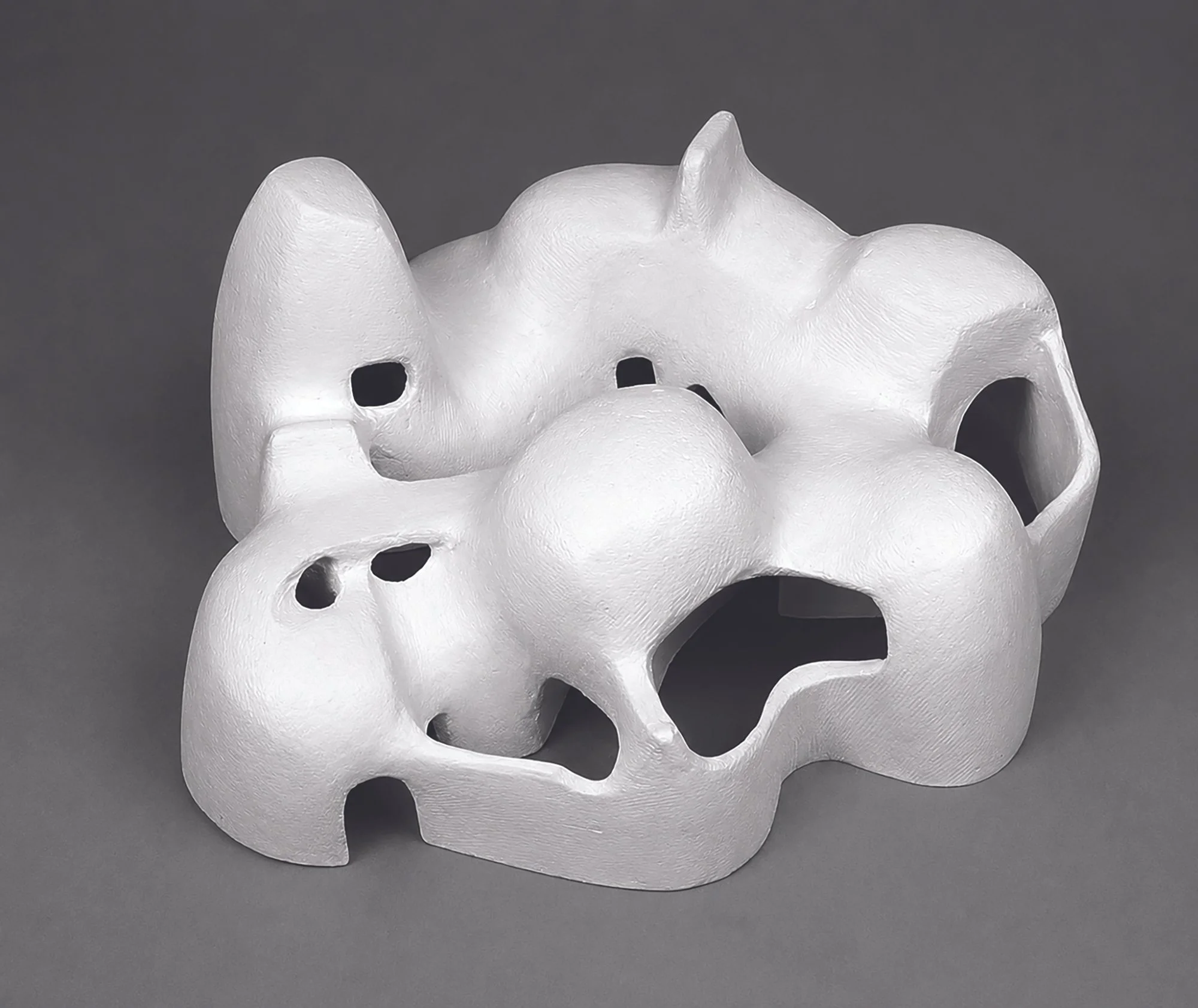
There were no formal architectural plans. The building was constructed from a small-scale plaster maquette*, titled Habitación, Carboneras, España, which today sits in the collection of the Musée National d'Art Moderne at the Centre Georges Pompidou in Paris. The builders worked from this model and from Claude Parent's on-site supervision rather than from technical drawings — an extraordinary approach for a building intended for habitation.
Materials — local and improvised
Claude Parent insisted from the outset on using only materials found in the immediate surroundings, and initially prohibited the use of cement entirely in pursuit of a form that would appear to emerge organically from the earth itself. The primary structural material was piedra molinera — millstone rock extracted directly from the land around the site — laid in traditional rubble masonry (mampostería*) and set in lime and sand mortar. The insistence on local-only materials was eventually partially abandoned: the mason, José Padua Díaz, persuaded Parent that some cement-based mortars were unavoidable, and so the external envelope was finished with a cement render over the lime masonry.
Brick arches were also necessary in certain locations, and the same brick was used to form the interior vaults and domes that give each room its distinctive curved ceiling. The carpentry for the building's small window and door openings was executed by a local carpenter, Salvador Alcorcón Vilar, who fixed timber directly into the masonry — no frames, no conventional joinery. For the floor, rounded basalt cobbles (guijarros de basalto) were gathered from a nearby dry riverbed and laid as the finished surface. Even water for mixing mortar had to be transported in drums from a nearby well known locally as El Pocico.
Form and structure -
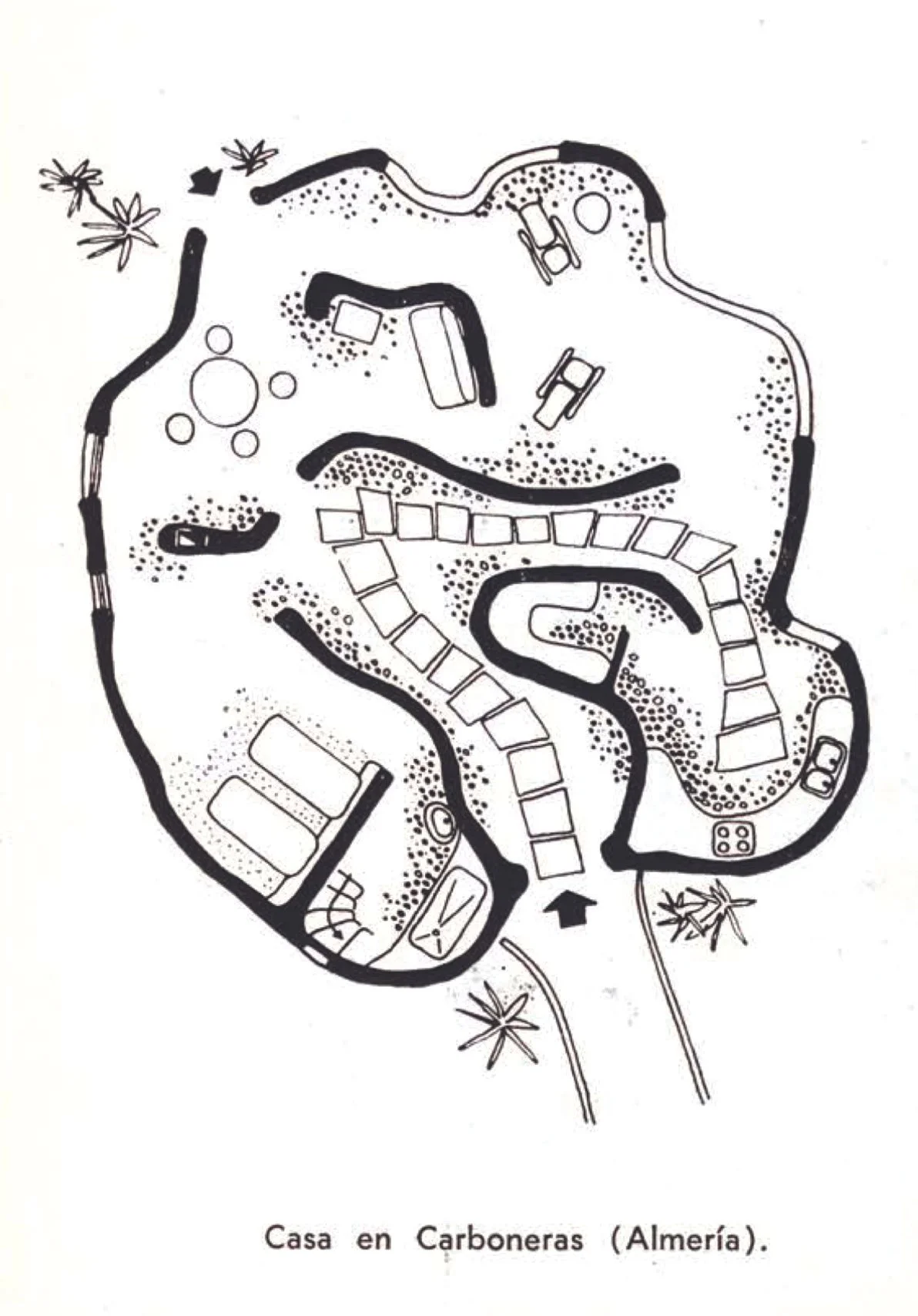
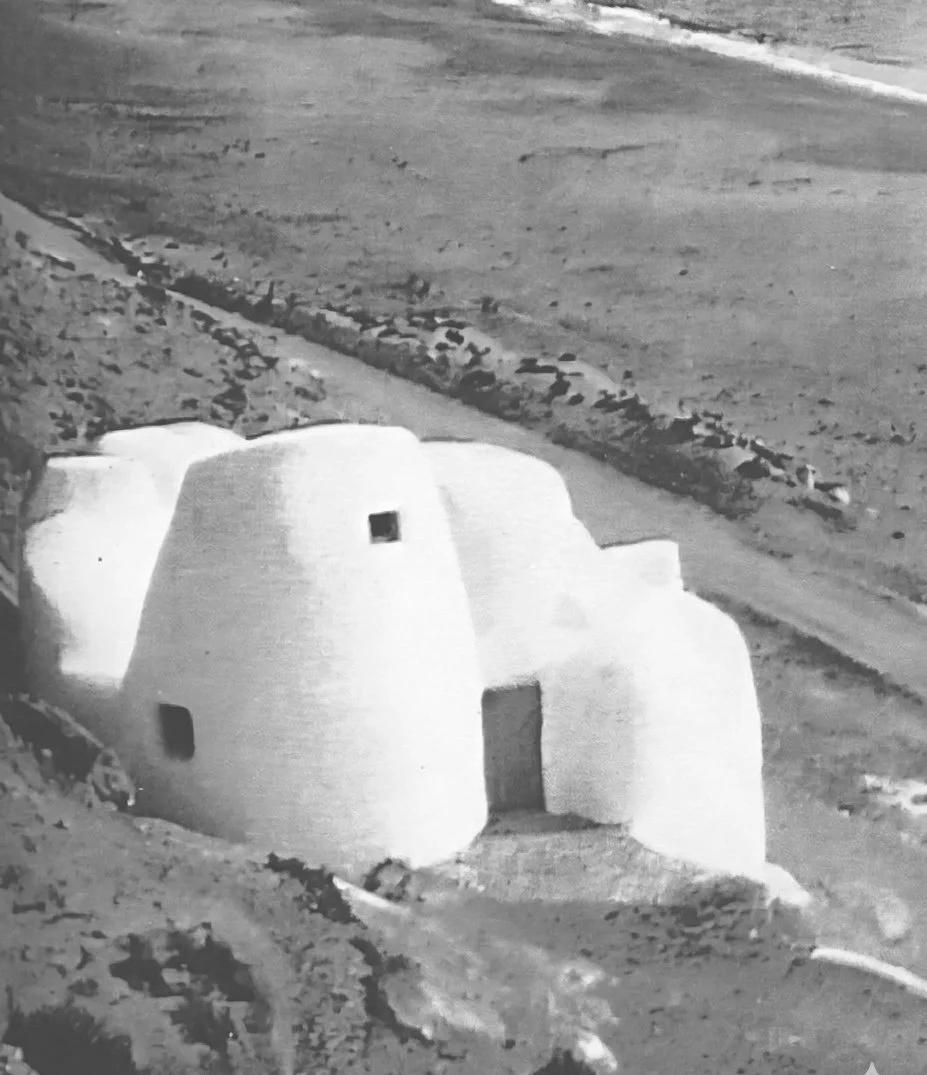
The building has an entirely continuous envelope — walls, vaults, and domes flow into one another without conventional junctions. Each room is covered by an irregular dome or barrel vault, and these read on the exterior as a sequence of undulating mounds emerging from the hillside. There are no interior doors — spaces connect through openings shaped as flowing voids in the thick walls. Light enters through a series of skylights (lucernarios*) punctuating the roof surface. The overall effect is closer to a cave or a grotto than to any conventional room, and the thick masonry mass provides considerable thermal inertia suited to the desert climate.
Labour -
The entire construction was carried out by José Padua Díaz and his two sons, José and Daniel, along with a small team of labourers from Carboneras — craftsmen entirely unfamiliar with anything resembling this form of building, working from a sculpture rather than a plan, under the direction of an architect supervising a project that was itself an experiment in the boundaries between art and construction.
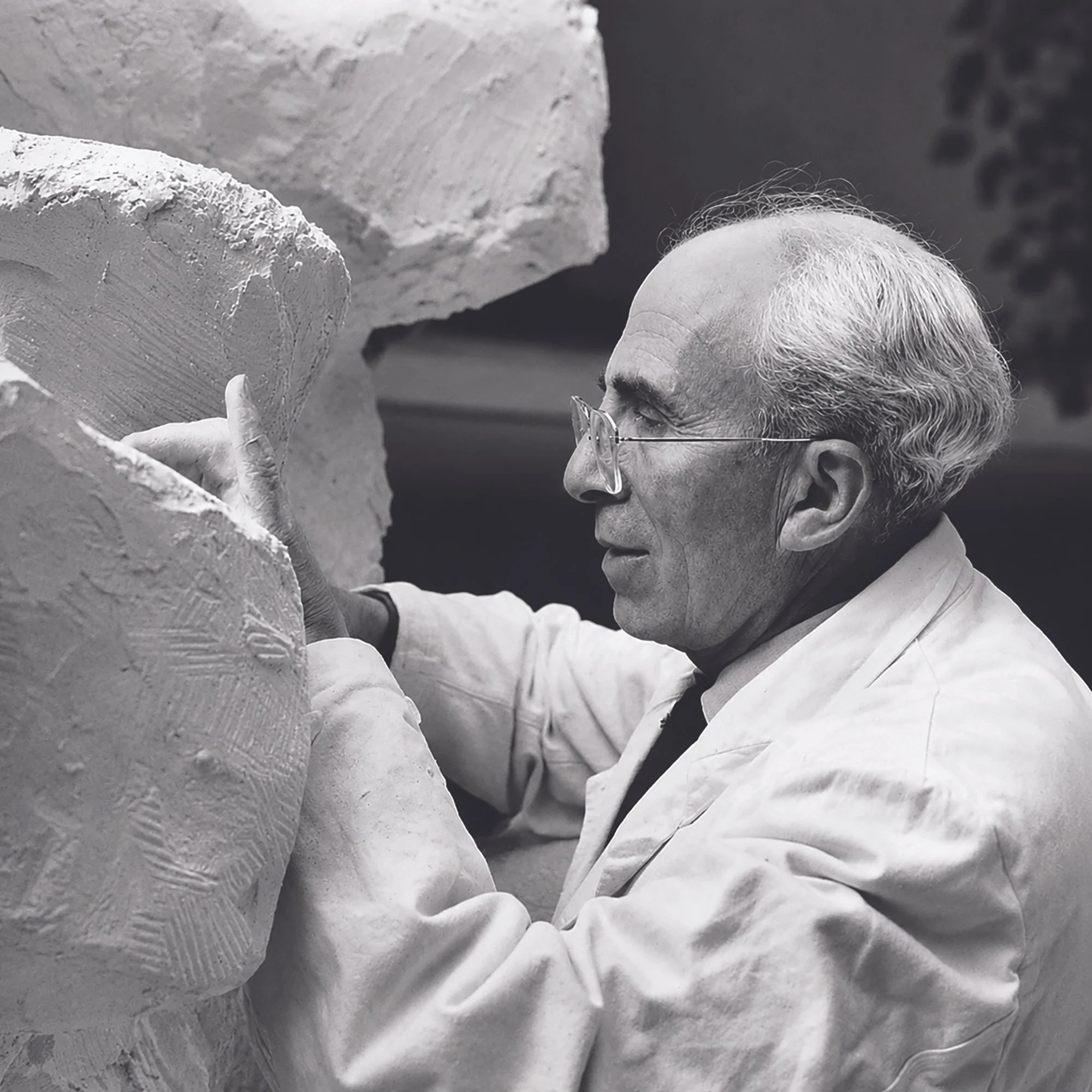
André Bloc was born into French colonial Algiers in 1896 and although leaving for his homeland as an infant it would be dismissive to conclude that the character of his birthplace, either through colonial inheritance or nascent connection, was without influence upon his later work. In Paris he attended the École Centrale and encountered both Le Corbusier and Auguste Perret in the 1920s. Perret was the great rationalist of reinforced concrete — structural clarity, classical order expressed in modern materials. Le Corbusier was pursuing the machine aesthetic, the white purism of the villas. Both represented a fundamentally geometric, grid-based conception of space. It was a western education in the fullest sense — rational, authored, imposed.
Yet Bloc moved in the late 1950s toward a sculptural approach to architecture that was almost the direct opposite of everything that education and his editorial career had championed — away from the rational and toward the cave-like, the continuous, the form generated by resistance rather than intention. He called these environments habitacles* — spaces conceived as neither sculpture nor architecture but occupying the charged ground between the two. Casa El Laberinto sits precisely at that turning point.
Take the Casbah* of Algiers. It was not designed. No single intelligence conceived it, no drawing preceded it, no authorial intention shaped its accumulated form. It grew — over centuries, under the compressive pressure of climate, topography, social organisation, and the materials that the immediate ground made available — into a spatial logic so coherent, so precisely fitted to its conditions, that the result reads as the work of a single sustained intelligence. But the intelligence was distributed. It belonged to no one maker and to every maker — to each generation that inherited a partial solution and adjusted it incrementally under the same fixed constraints its predecessors had faced.
And consider the mud architecture of the Maghreb, because here the material is not merely local — it is the ground itself. Adobe and rammed earth construction takes the site and compresses it into walls. The building is literally made of the place it stands on. Across the pre-Saharan and Saharan zones of Algeria, Morocco, and Tunisia, the dominant forms are the ksar* — a fortified communal settlement — and the kasbah* — a fortified residence or administrative structure. Structures in these regions are largely made of rammed earth, mudbrick, rough stone, or a mix of these. The material dictates everything: how thick the walls must be to stand, how openings must be kept small to maintain structural integrity, how the roof must resolve into vaults and domes because spanning in mud brick without timber demands the arch as its only viable solution. Thick earthen walls regulate indoor temperature naturally, while small openings and ventilation shafts ensure airflow and light without mechanical means. The geometry is not ornamental — it is structural physics made visible.
In the Gourara region of western Algeria — deep Saharan territory, hot desert at its most absolute — conical domes with circular bases were built from adobe bricks and rubble stone, their continuous curved surfaces emerging not from design intention but from the logic of spanning in earth without any other means. The same region produced the foggara* — a system of underground channels conducting water from a subterranean aquifer across desert terrain by gravity alone, sometimes for kilometres, without drawings, without mechanical intervention, by the same incremental intelligence that built the cañada y boquera on the mountain above Vélez Blanco. These forms — unbroken envelopes, vaulted interiors, surfaces flowing from wall to ceiling without conventional junction — are the direct structural consequence of the material and the climate. They are also, formally, almost exactly what Bloc produced at Carboneras in stone and lime mortar in 1962. The techniques themselves are ancient — continuous across millennia, not because they were preserved as tradition but because the conditions that generated them never changed. The same climate, the same material, the same structural logic, the same form. Generation after generation, in the absence of any other viable solution.
Almería was not simply near North Africa — it was, for eight centuries, continuous with it. As a principal port of al-Andalus*, the city and its province were the point of most intimate exchange between the Iberian peninsula and the Maghreb: the same builders, the same materials, the same climatic logic operating on both shores of the same sea. The architecture that accumulated across the province under Moorish rule was not an import — it was the same tradition, rooted in the same conditions, expressing itself in the same forms. Thick walls of rubble stone and lime mortar. Minimal openings. Interior courtyards drawing light downward and air upward. Vaulted and domed ceilings resolving the structural problem of spanning in heavy masonry. Surfaces whitewashed against a light that bleaches and a heat that penetrates. And carved into the hillsides across the province, the cuevas — cave dwellings cut directly into the rock, their interiors continuous, cool, vaulted, lit from small apertures — spaces that did not imitate the cave but were the cave, the oldest and most literal form of the argument that shelter is what the ground offers when you submit to it rather than impose upon it.
This was the architecture Bloc encountered at Carboneras in the late 1950s. Not in books or journals — he could see it from where he stood. The flat-roofed cubic vernacular of the coastal village, the thick walls, the small windows, the thermal mass — the same proportional logic as the medina house, arrived at by the same route: the same climate, the same material, the same structural necessity. It was the immediate and physical presence of what the Casbah represented at urban scale, what the ksour of the pre-Sahara represented in earthwork and adobe — the conditional logic of building in an arid climate with what the ground provides, producing the same spatial answers it had always produced, legible in every wall and roofline within sight of where he was working.
B
The same arid climate, the same absence of timber, the same calcareous ground, the same human body working without drawings — these are not cultural conditions but physical ones. They do not produce related forms. They produce the same form. The Casbah, the ksour of the pre-Sahara, the cañada y boquera on the mountain above Vélez Blanco, the cave-like continuous envelope of Casa El Laberinto — these are not a family of influences. They are a single answer to a single set of questions that the ground, the climate, and the material have always posed, and will always pose, to any human body that engages with them seriously enough.
This is where the accumulated form of the Casbah of Algiers, the mud architecture of the Maghreb, the vernacular of al-Andalus, and the cañada y boquera above Vélez Blanco converge most precisely — not as cultural relatives but as conditional ones. All four are responses to arid climates, all four built from what the immediate ground provides, all four arrived at incrementally by makers working under fixed constraints, all four producing forms of such internal coherence that they read as designed. None was. And all four, in their different registers — one urban and domestic, one agricultural and hydraulic, one geological and inhabited, one sculptural and authored — produced forms that a French sculptor working without drawings on the coast of Almería would independently rediscover, simply by submitting to the same conditions they had always answered to.
The Algerian vernacular he left at age two is more present in that building than anyone has noticed — not as conscious memory or deliberate citation, but as something that persisted below the reach of his rationalist education, and resurfaced the moment he abandoned drawings, imposed no geometry, and let the ground and the material decide.
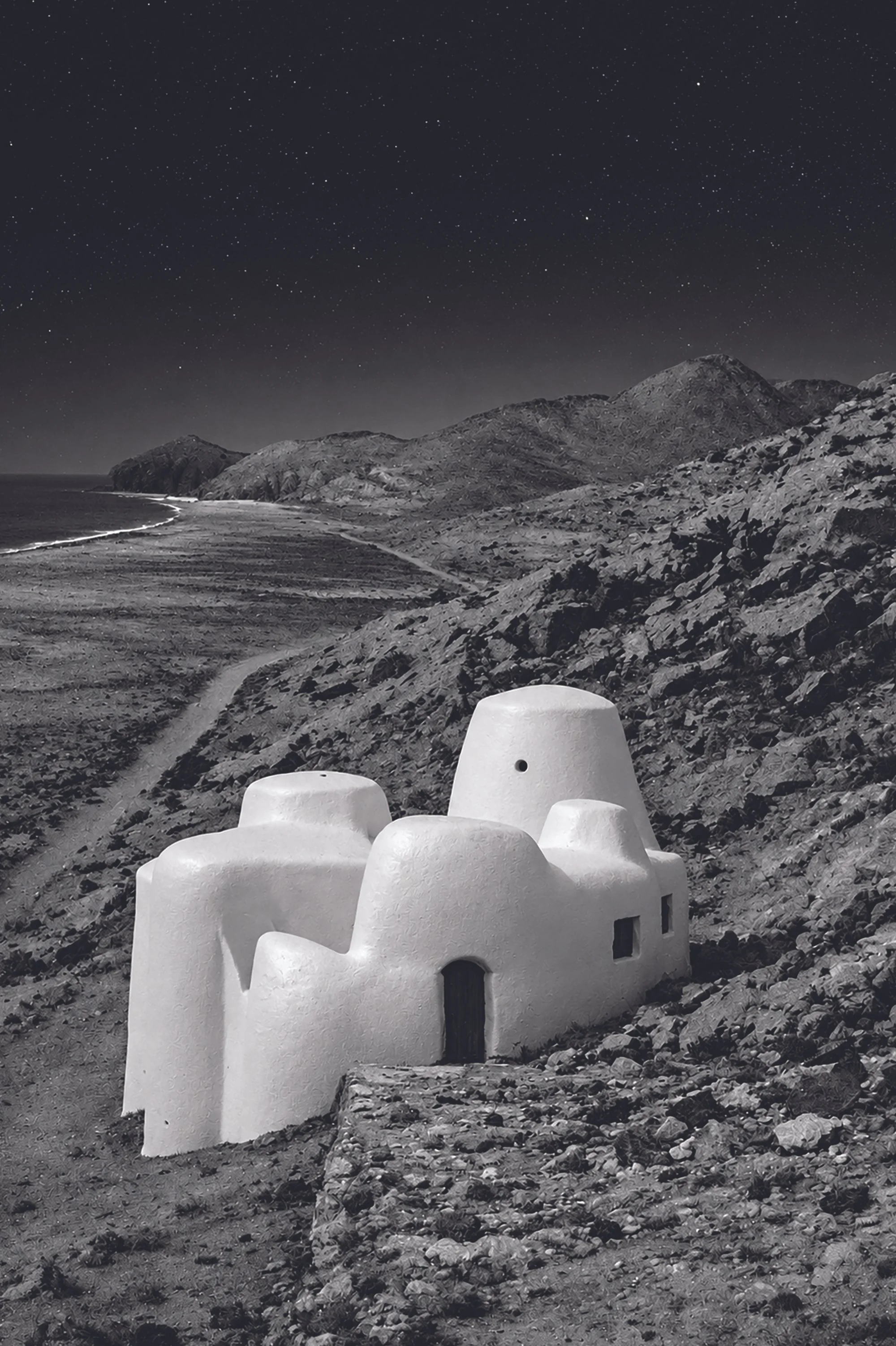
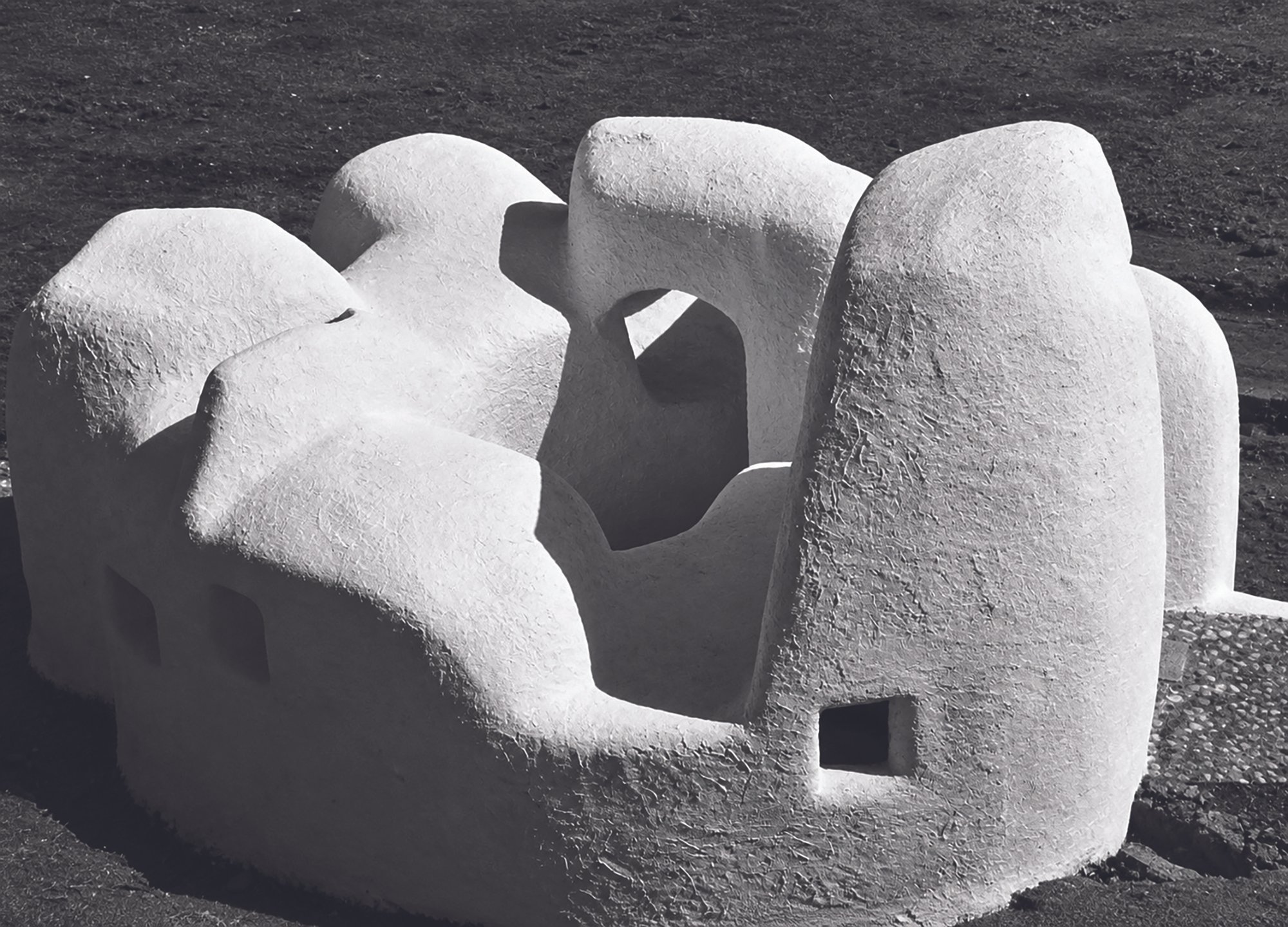
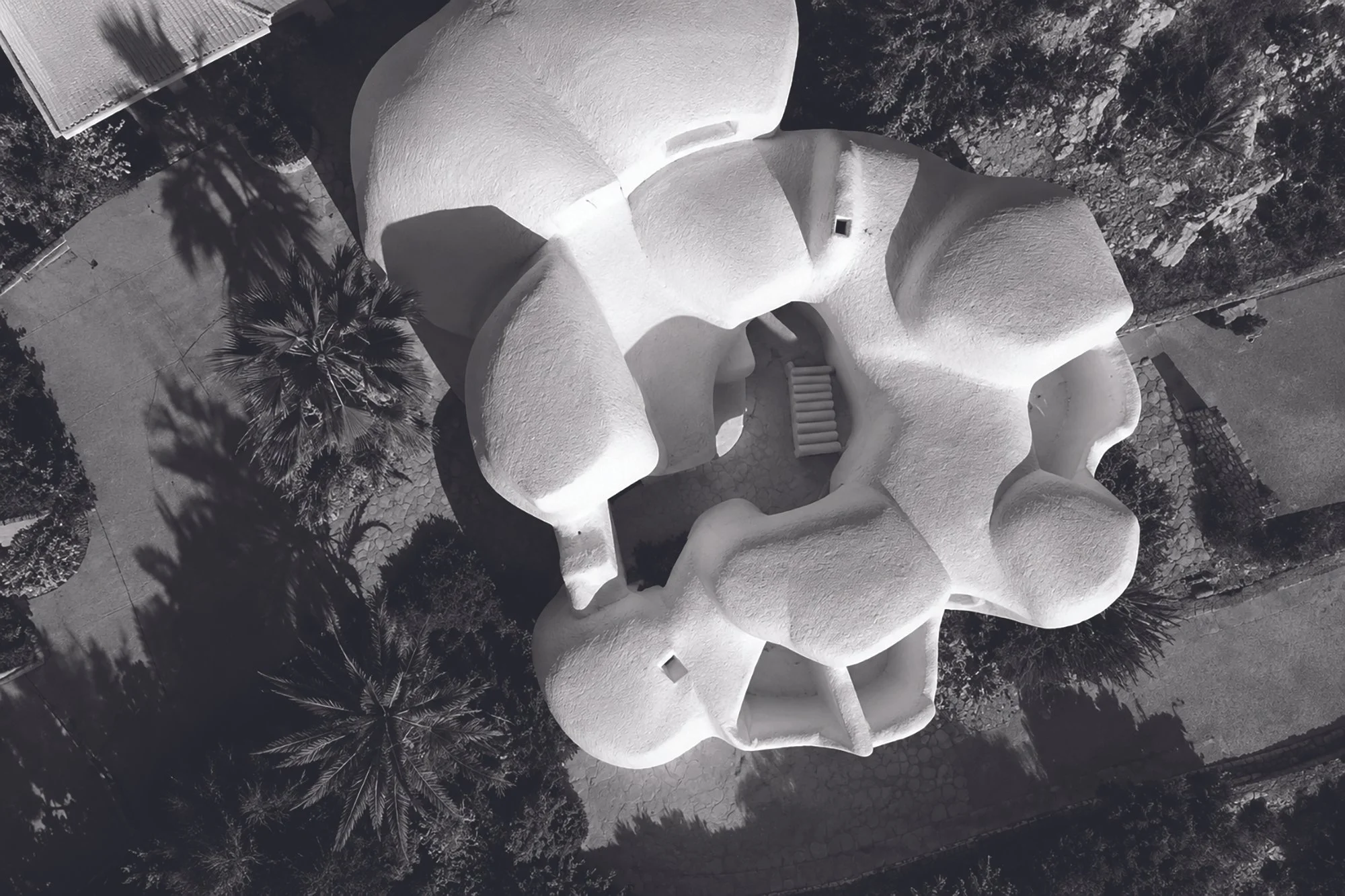
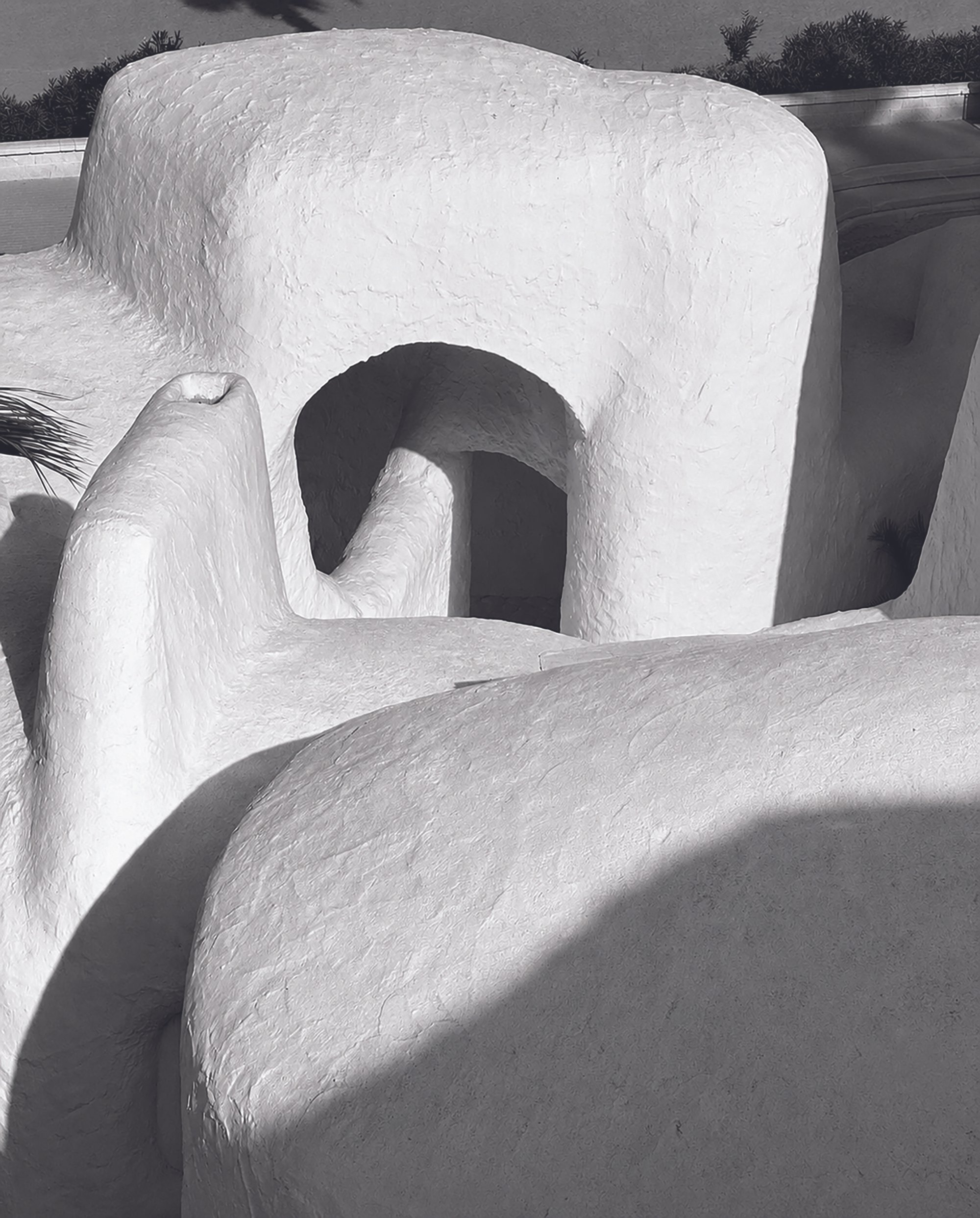
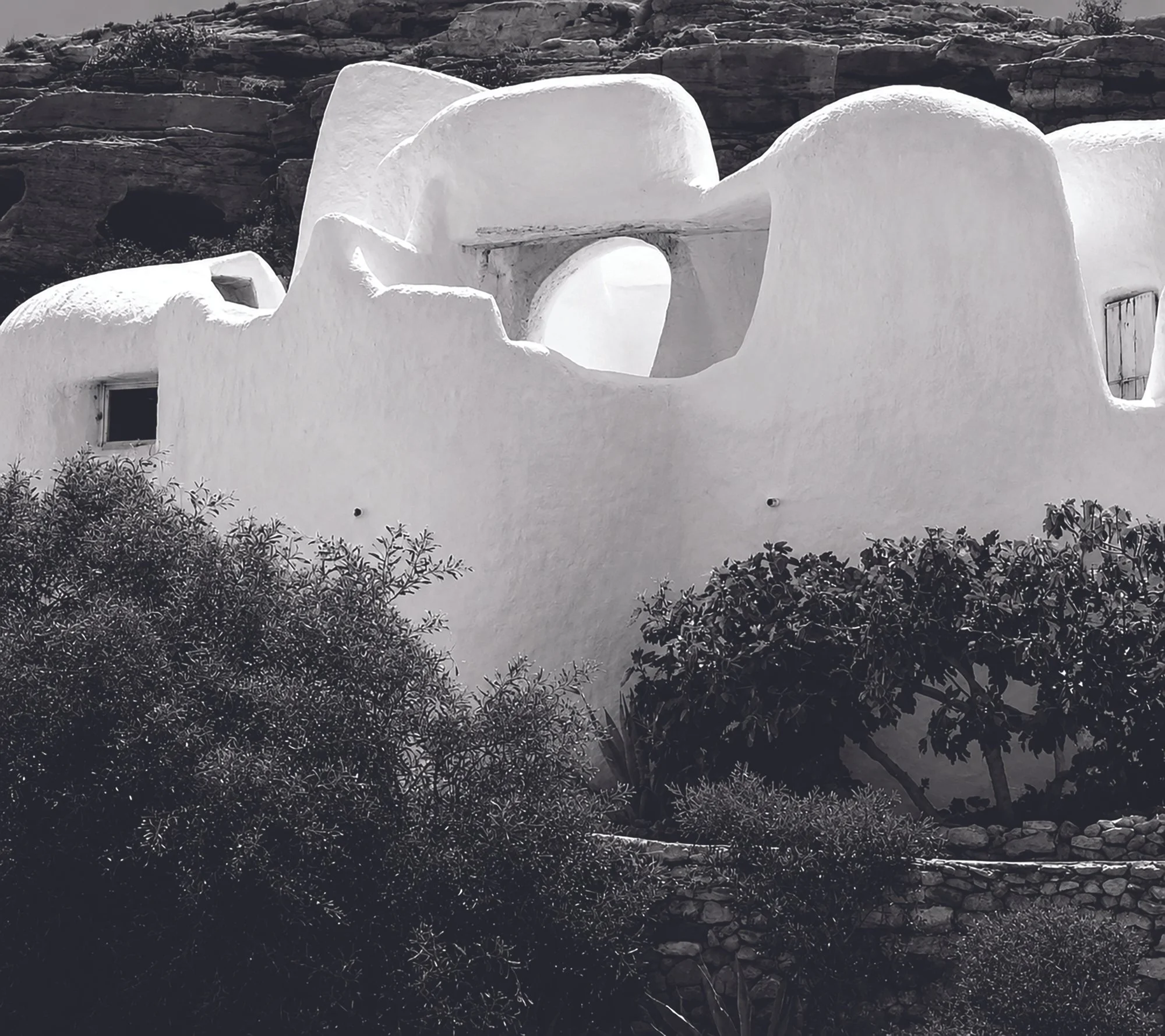
There is a category of knowledge that belongs to neither the scholar nor the practitioner alone. It emerges in the act of sustained attention — in the slow, repeated encounter with a thing until the thing declares what it is. The cañada y boquera declared itself over twenty years of consideration. Casa El Laberinto declared itself the moment its construction was stripped of everything that conventional architecture requires — drawings, plans, the mediating apparatus of professional knowledge — and submitted instead to a plaster model, a local mason, and the resistance of the immediate ground. In both cases, the form that resulted was not chosen. It was arrived at. And what was arrived at, in each case, was the same.
This convergence is not coincidence and it is not influence. It is condition. The ground of Almería has always posed the same questions — of water, of shelter, of how to endure in a landscape that offers almost nothing freely — and it has always produced the same answers, because there is only one. The labrador de tierra on the dry mountain above Vélez Blanco and the homme de synthèse on the desert coast two hundred kilometres to the south were not in conversation. They did not know each other. They did not need to. The ground knew them both, and answered through them in the same terms it has always used: mass, vault, the careful management of water and light, the form that is not designed but deposited — laid down by the pressure of conditions that have no interest in human intention and every interest in human submission.
Bloc was not the only cultural practitioner drawn to this landscape in the mid-twentieth century, nor the only one to find in its marginal conditions the freedom that more established centres could not offer. The Movimiento Indaliano, founded by Jesús de Perceval in Almería in 1943, had claimed the province as the ground for a distinctly local aesthetic regeneration, retrieving the prehistoric Indalo* figure from the cave art of Vélez Blanco as the emblem of a cultural identity rooted in the south and resistant to the centralising pressures of Francoism. A decade later, AFAL — the Agrupación Fotográfica Almeriense, founded by Carlos Pérez Siquier and José María Artero in 1950 — was connecting this same remote province to the international photographic avant-garde, at a moment when Spain was almost entirely isolated from it. Both movements found, independently and through entirely different means, that the margins offered what the centre withheld: the freedom to see clearly, and to make honestly. Bloc arrived into that field. It was not empty.
What the history of art has failed to see, and what the history of agriculture has never thought to ask, is that these two categories of making — the anonymous and functional, the authored and artistic — are not opposites. They are the same act performed at different scales, in different registers, by makers whose names and ambitions could not be more different, but whose encounter with the same resistant ground produced the same inevitable form. To place them in relation, as this book does, is not to diminish the sculptor by comparison with the farmer, nor to elevate the farmer at the sculptor's expense. It is to propose that the most fundamental category of aesthetic experience is not authorship but condition — not who made the thing, but what the thing had to be, given where it was made, and from what, and under what sky.
The drawings in this book are an argument for that proposition. They are not illustrations. They are acts of recovery — the recovery of a form from the deterioration that concealed it, and the recovery of an intelligence from the anonymity that history assigned it. To draw the cañada y boquera is to insist that it belongs in the same conversation as Casa El Laberinto. To place those drawings alongside Bloc's forms is to propose that the conversation was always happening — in the ground, in the climate, in the calcareous resistance of a landscape that has never distinguished between the farmer and the sculptor, between the functional and the aesthetic, between the necessary and the beautiful. In Almería, these have always been the same thing. The drawings are why.
Simon Beckmann
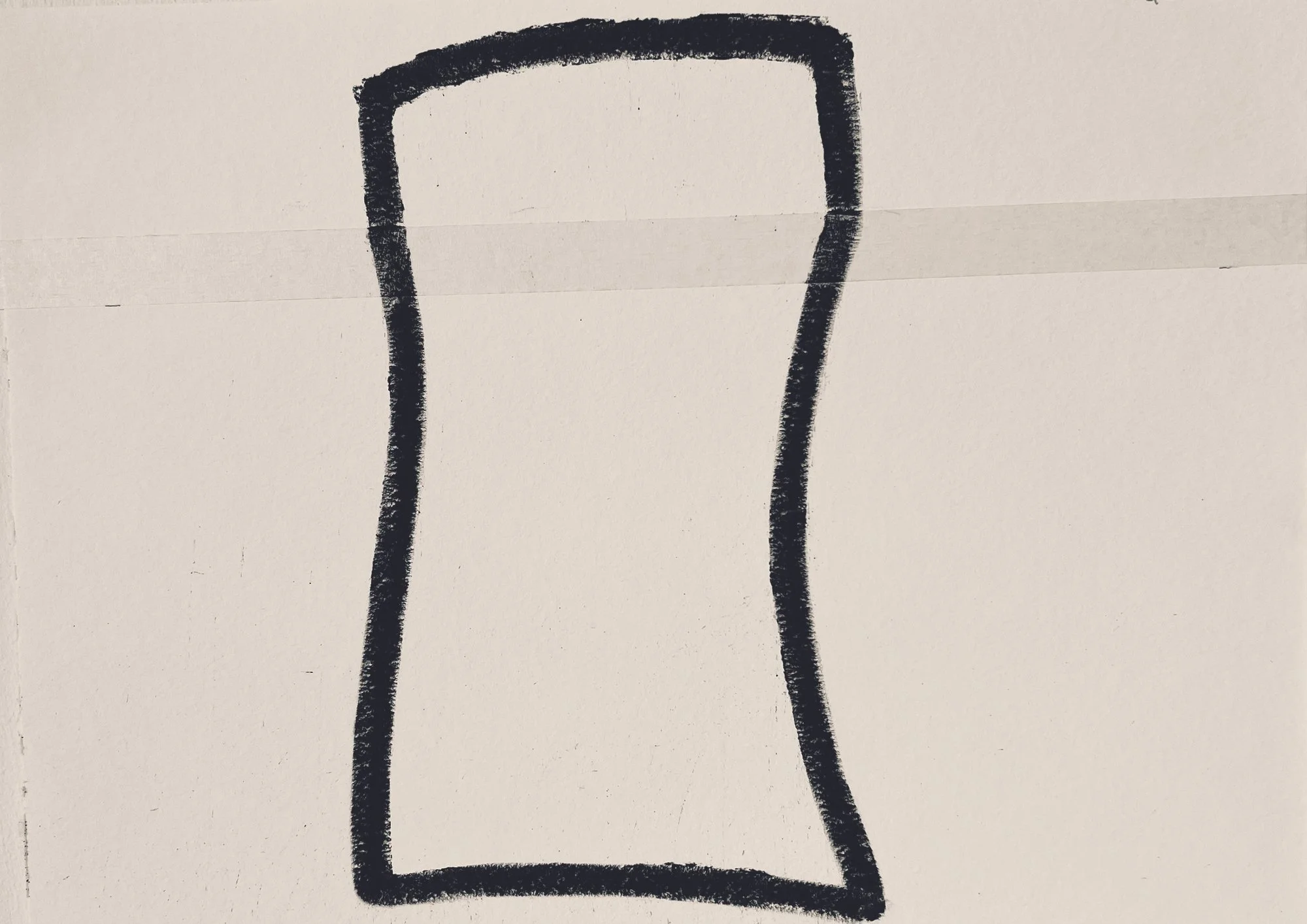
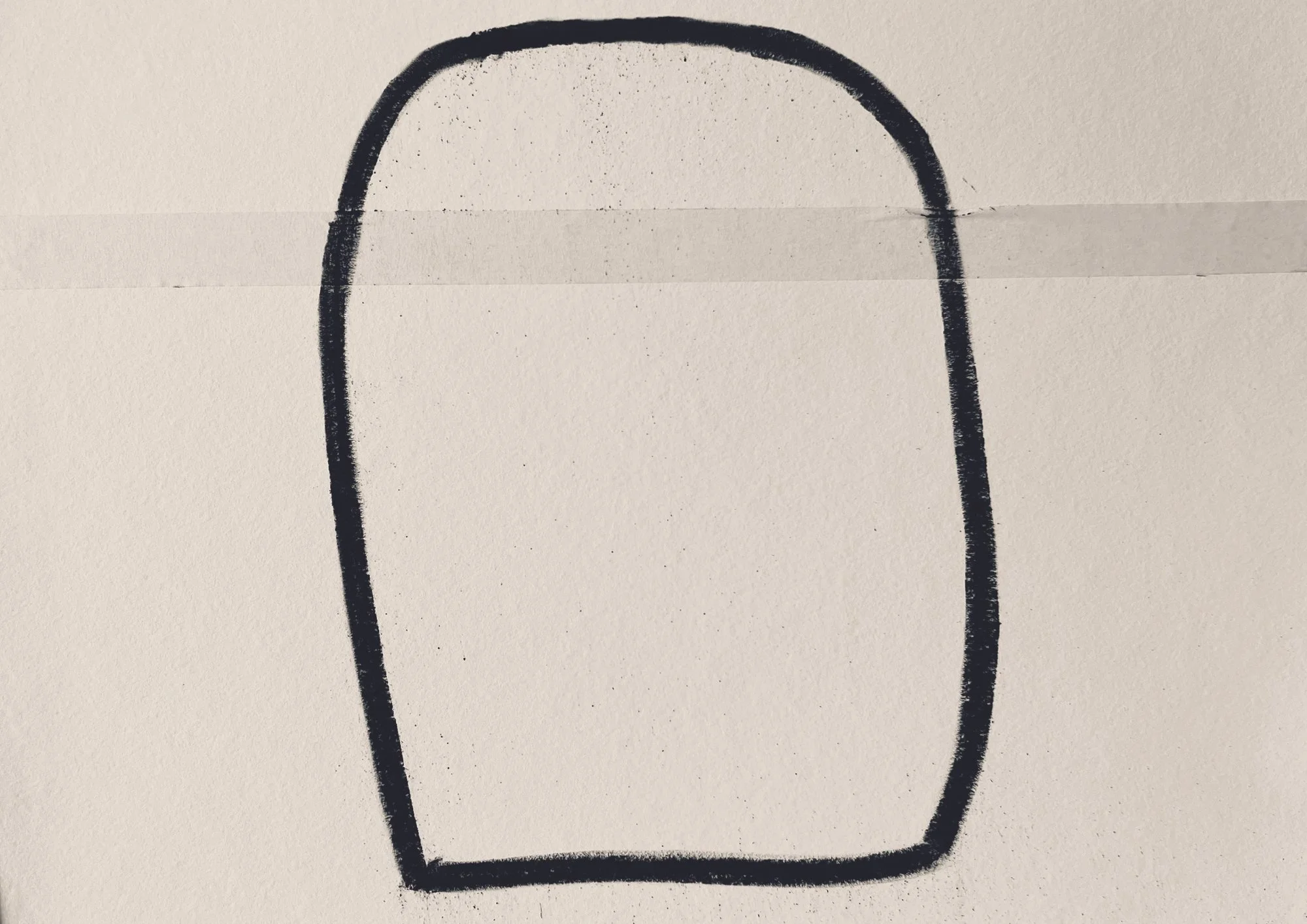
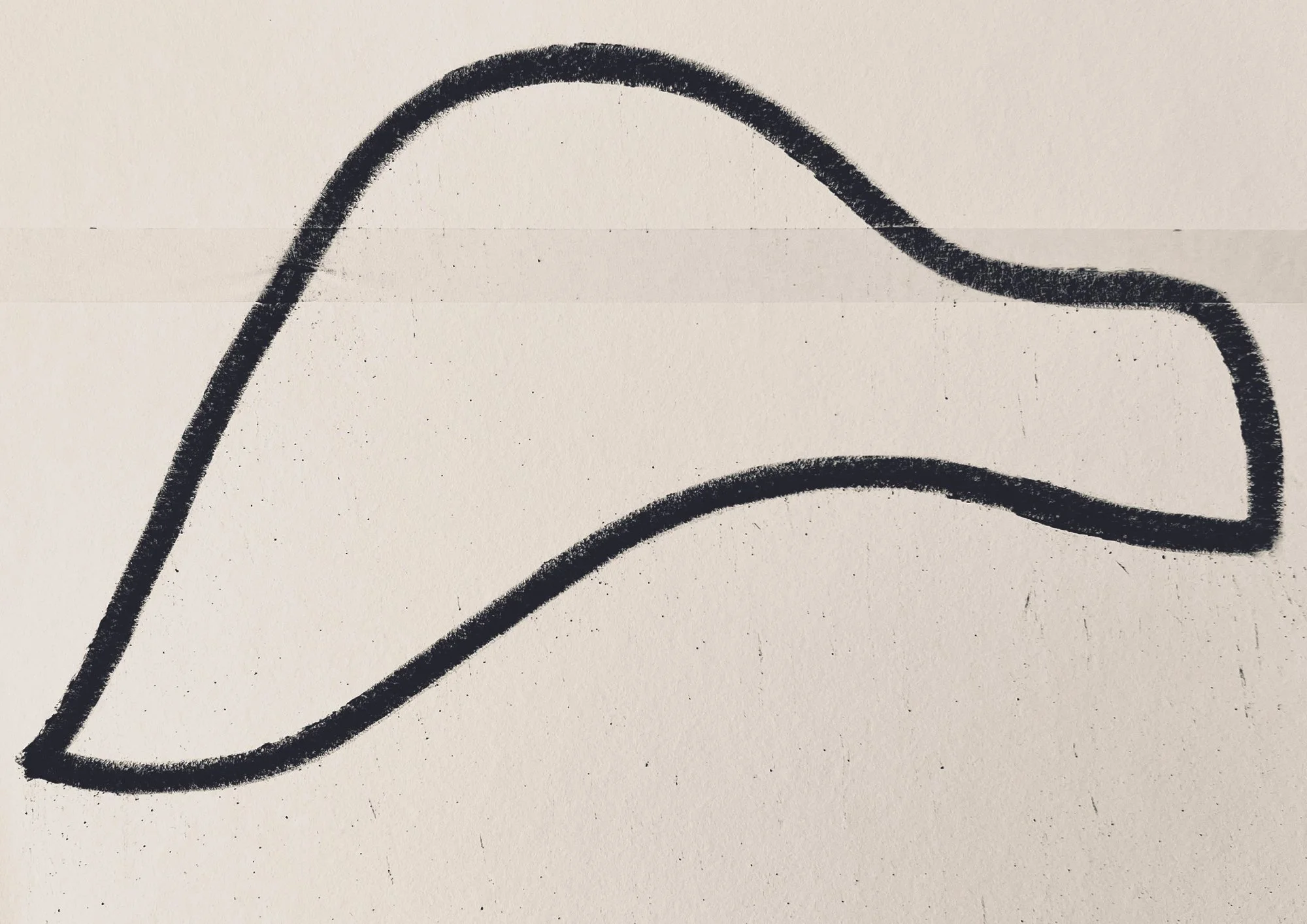
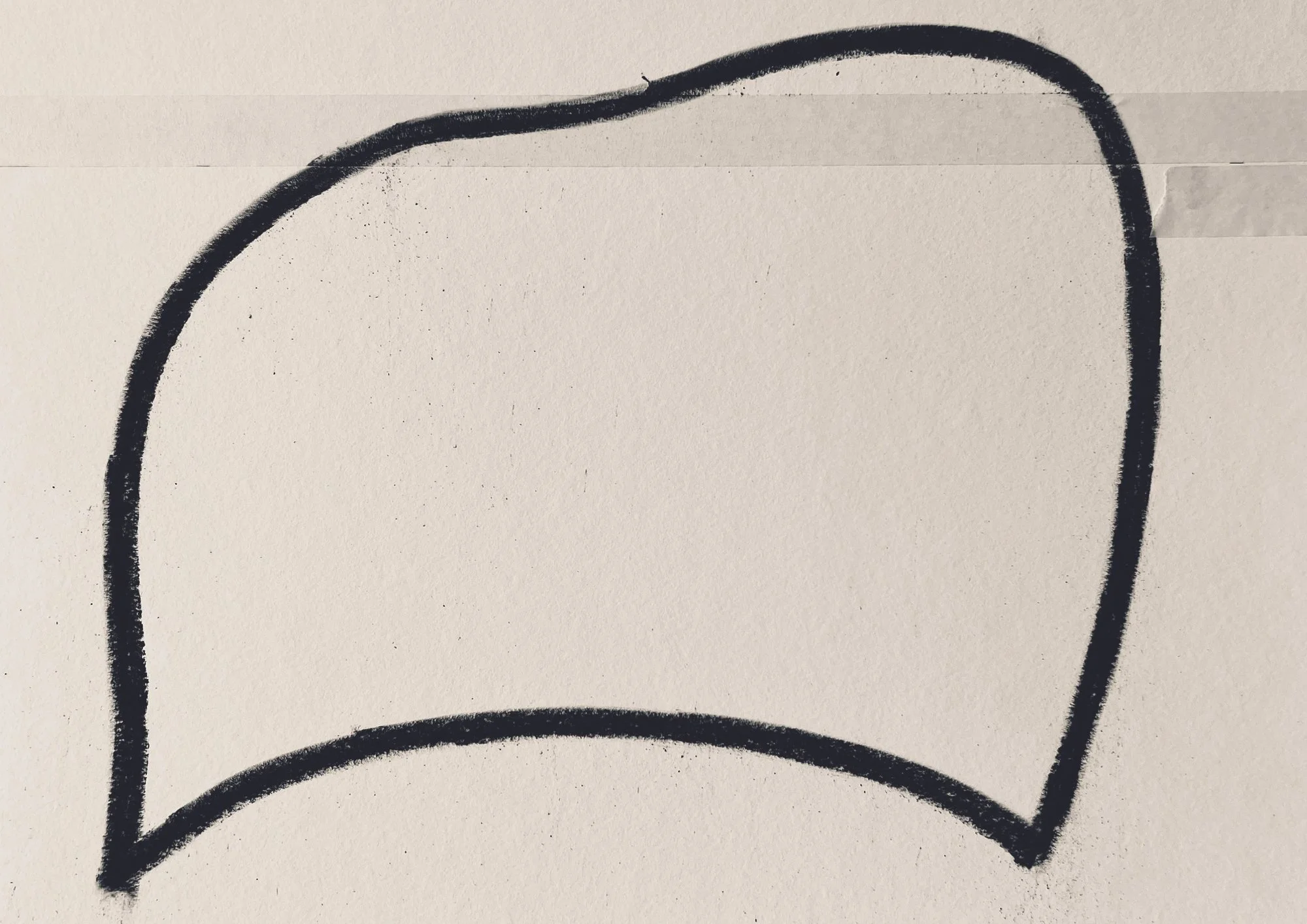
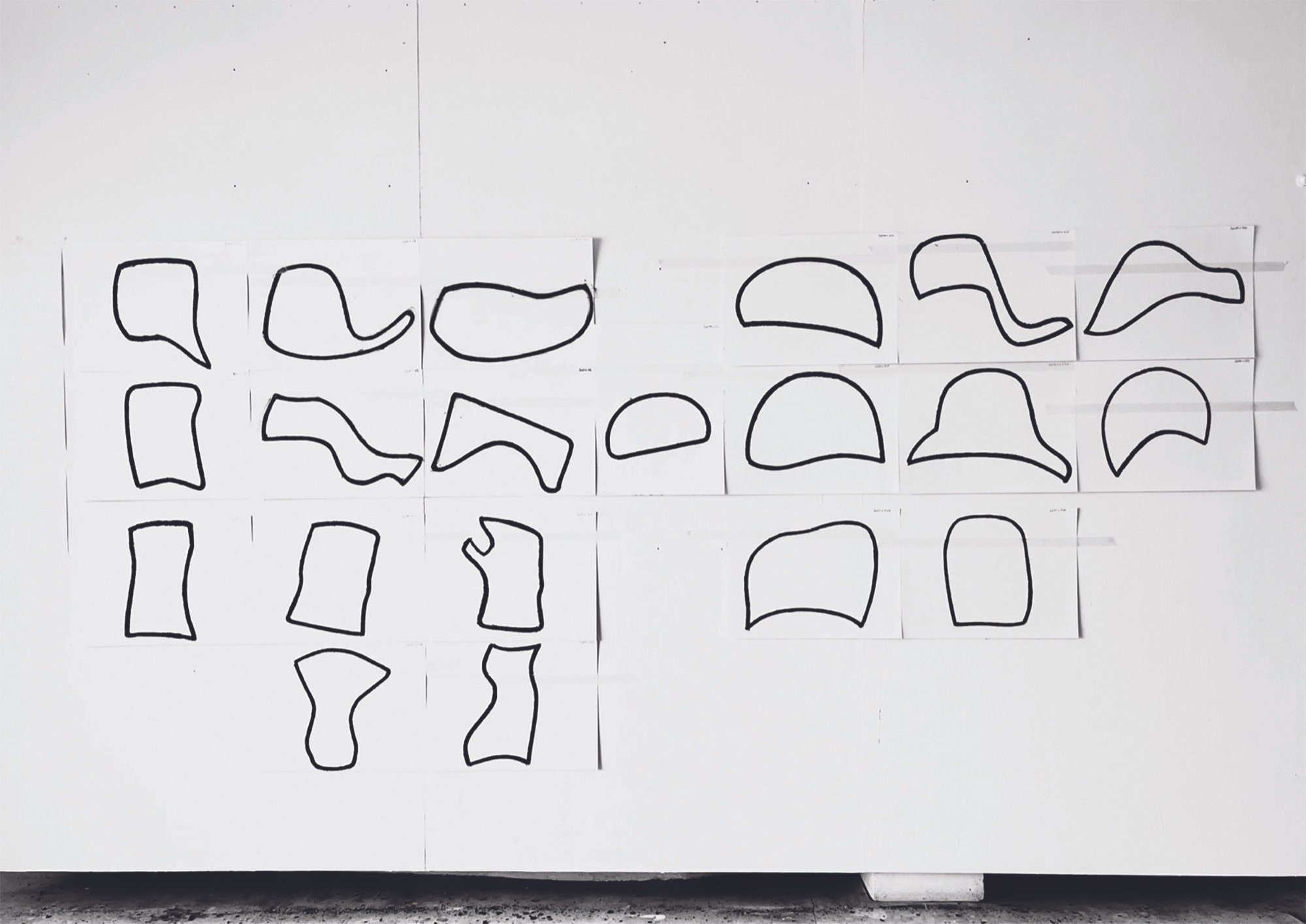
deposition
clay works
The two projects outlined here develop from the same proposition: that form is not simply authored, represented or imposed, but produced through the encounter between body, material, terrain and condition. Both emerge from the cañada y boquera as a located hydrological and spacial system, but they act upon that system differently.
Deposition remains territorial and infrastructural, marking the point where the landscape’s hydrological logic is most concentrated.
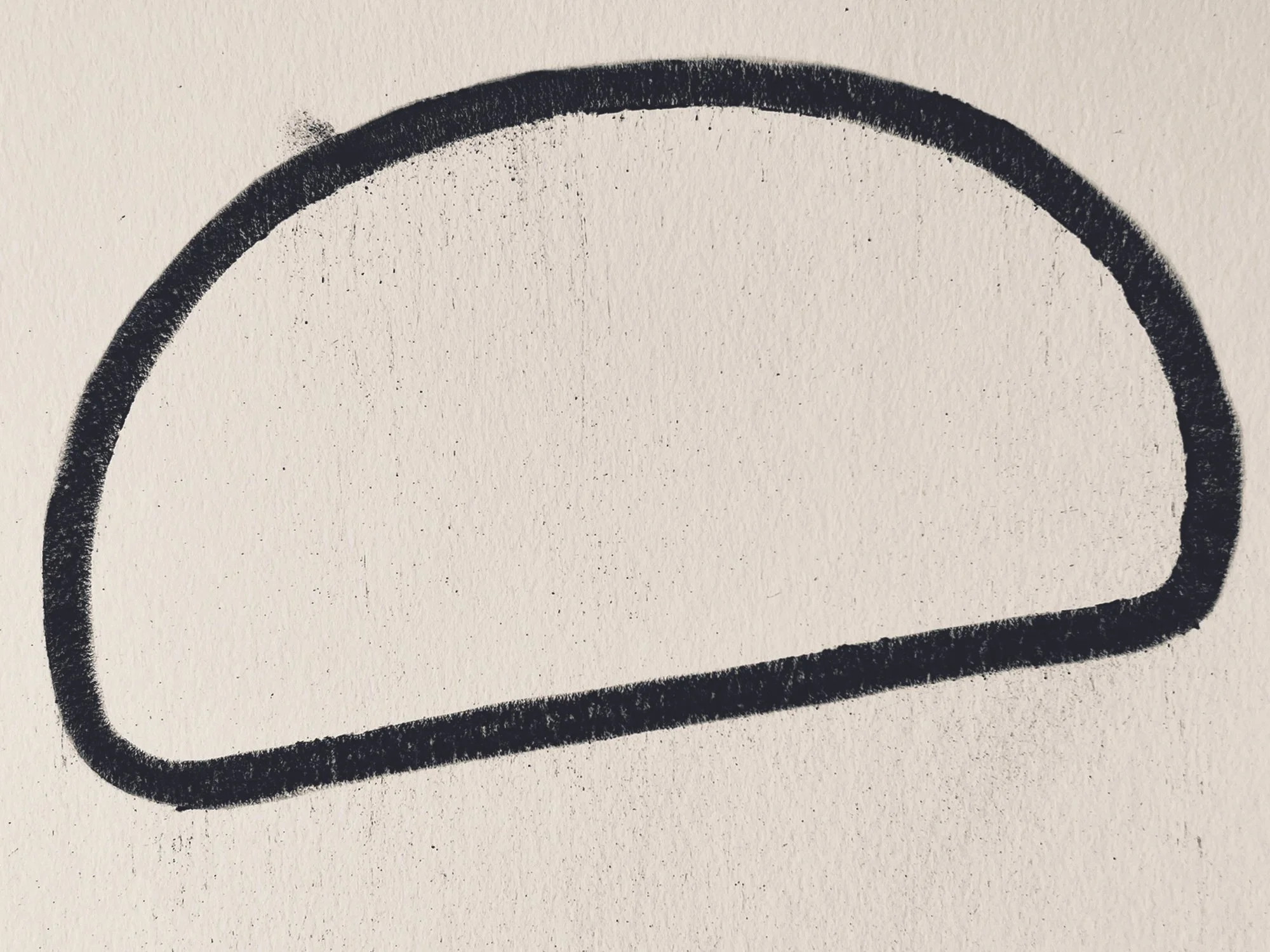
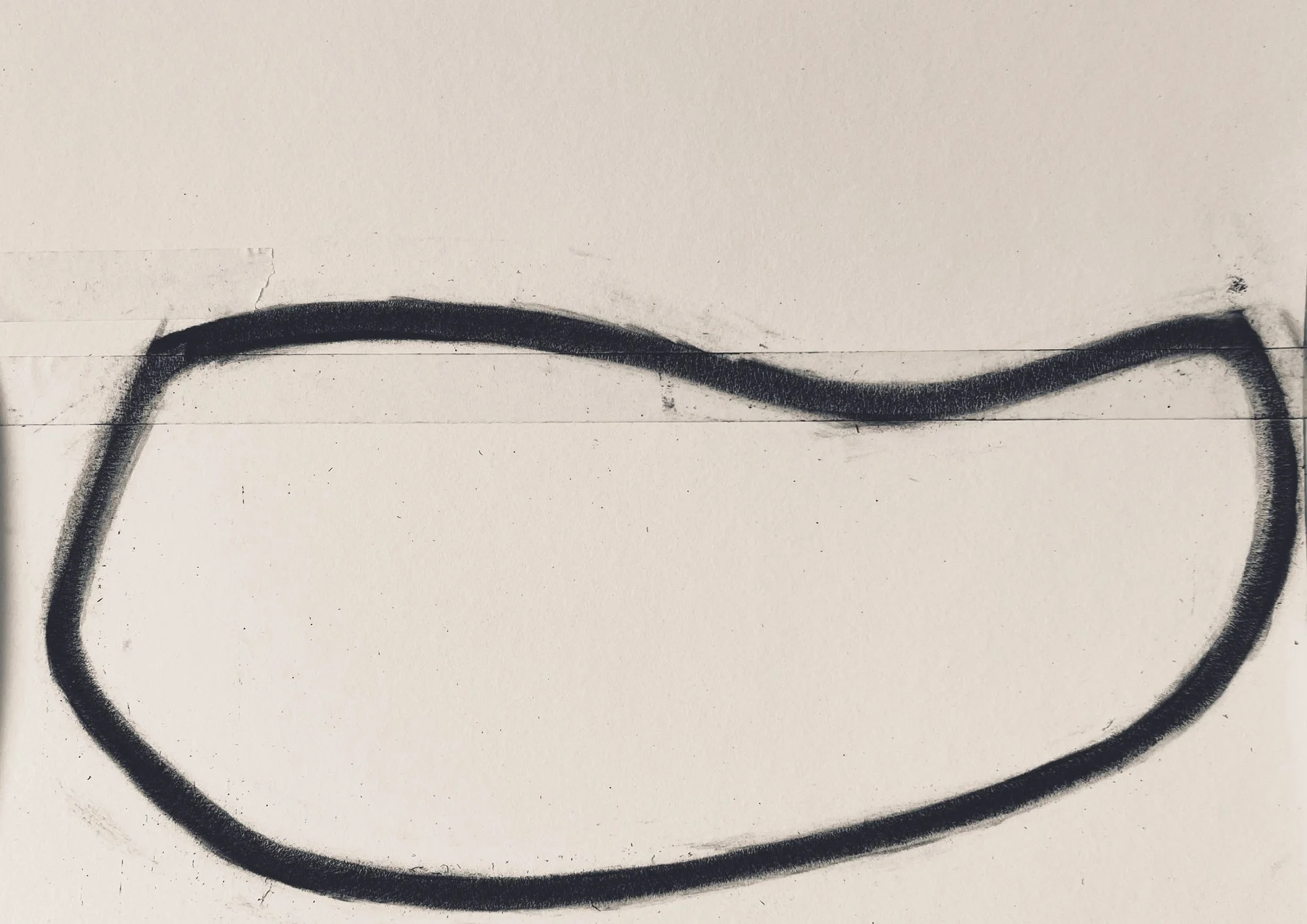
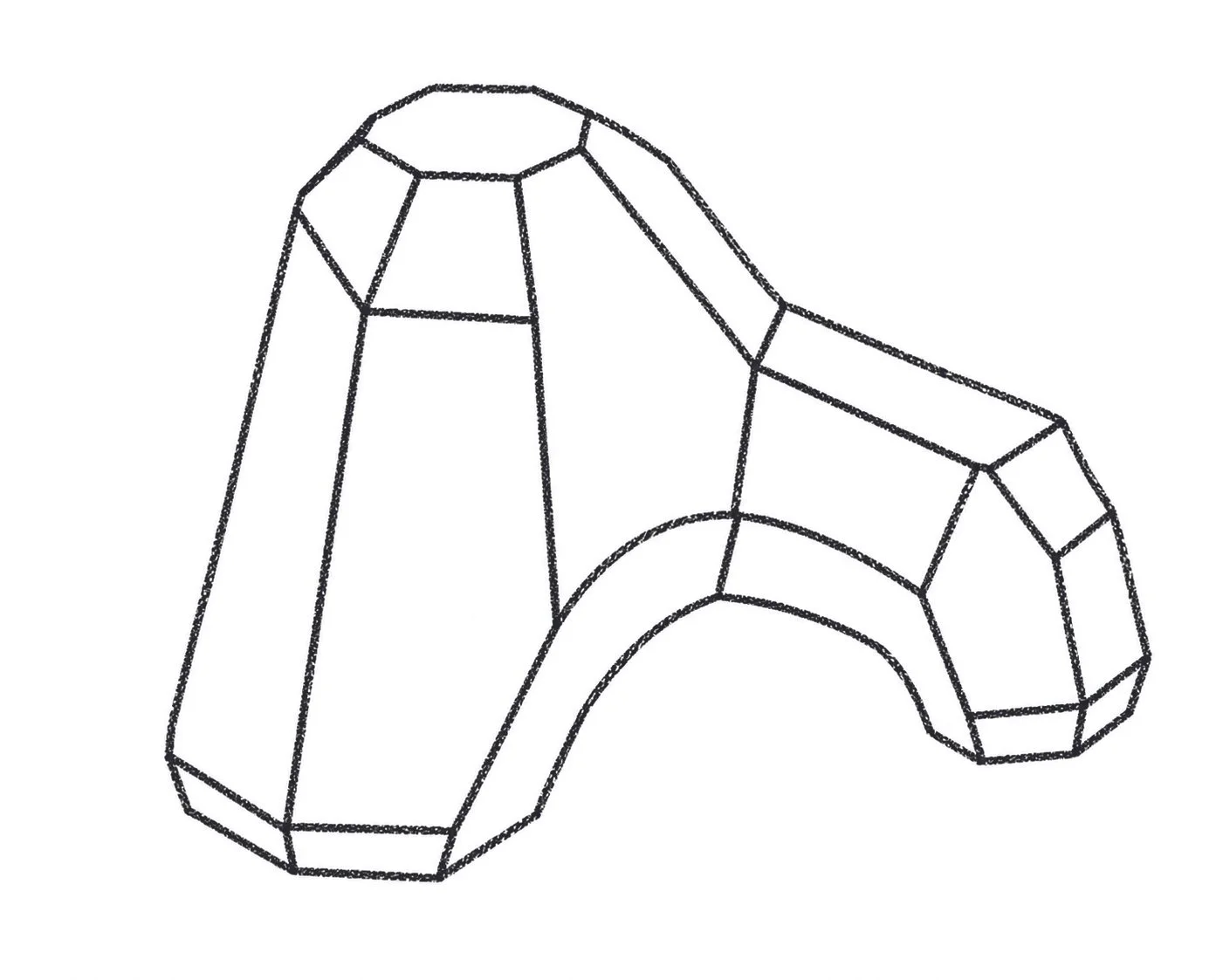
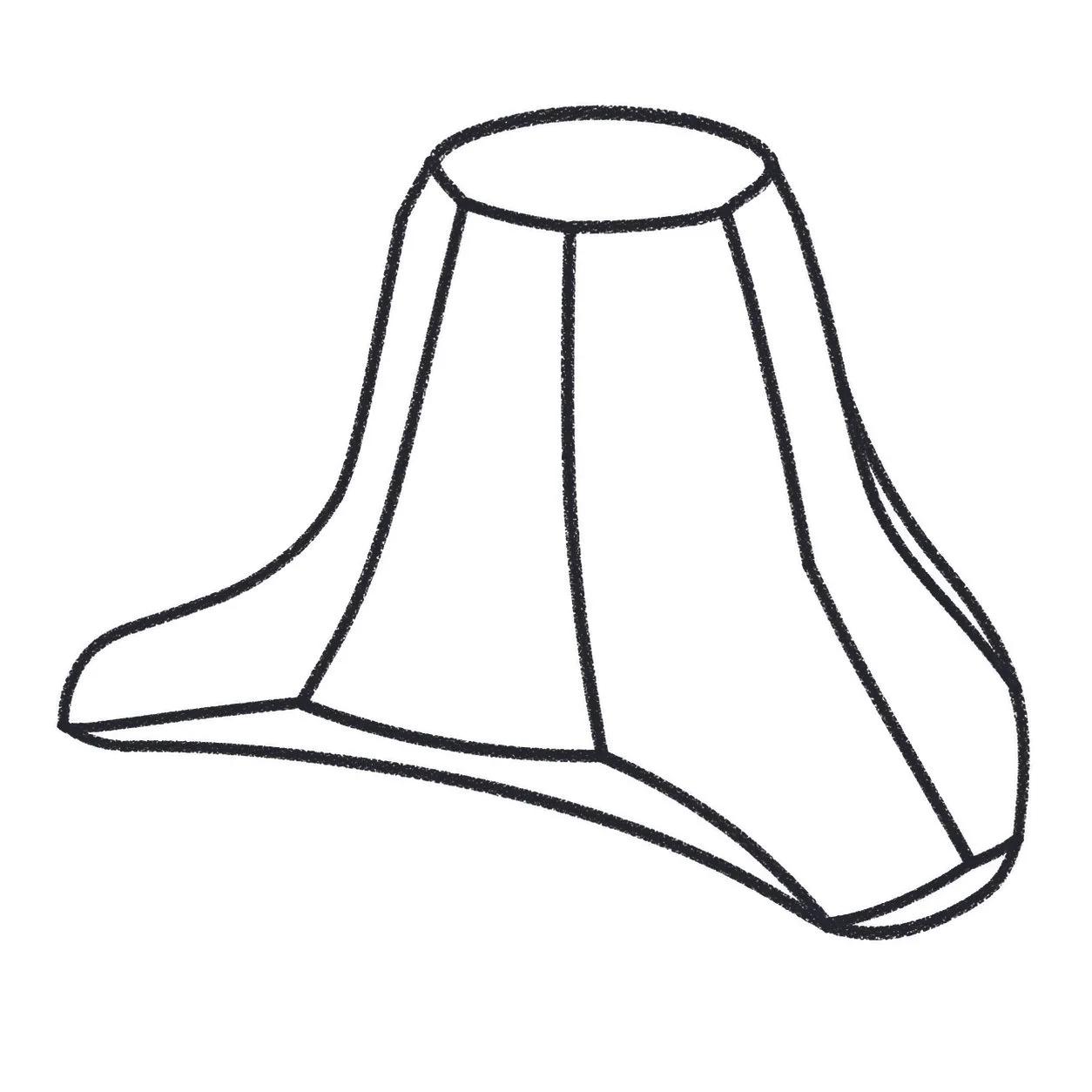
Clay Works translates plan-based field information into sculptural volume, subjecting drawing to gravity, clay and bodily negotiation. Together the works extend the argument from located drawing into material and spacial practice.
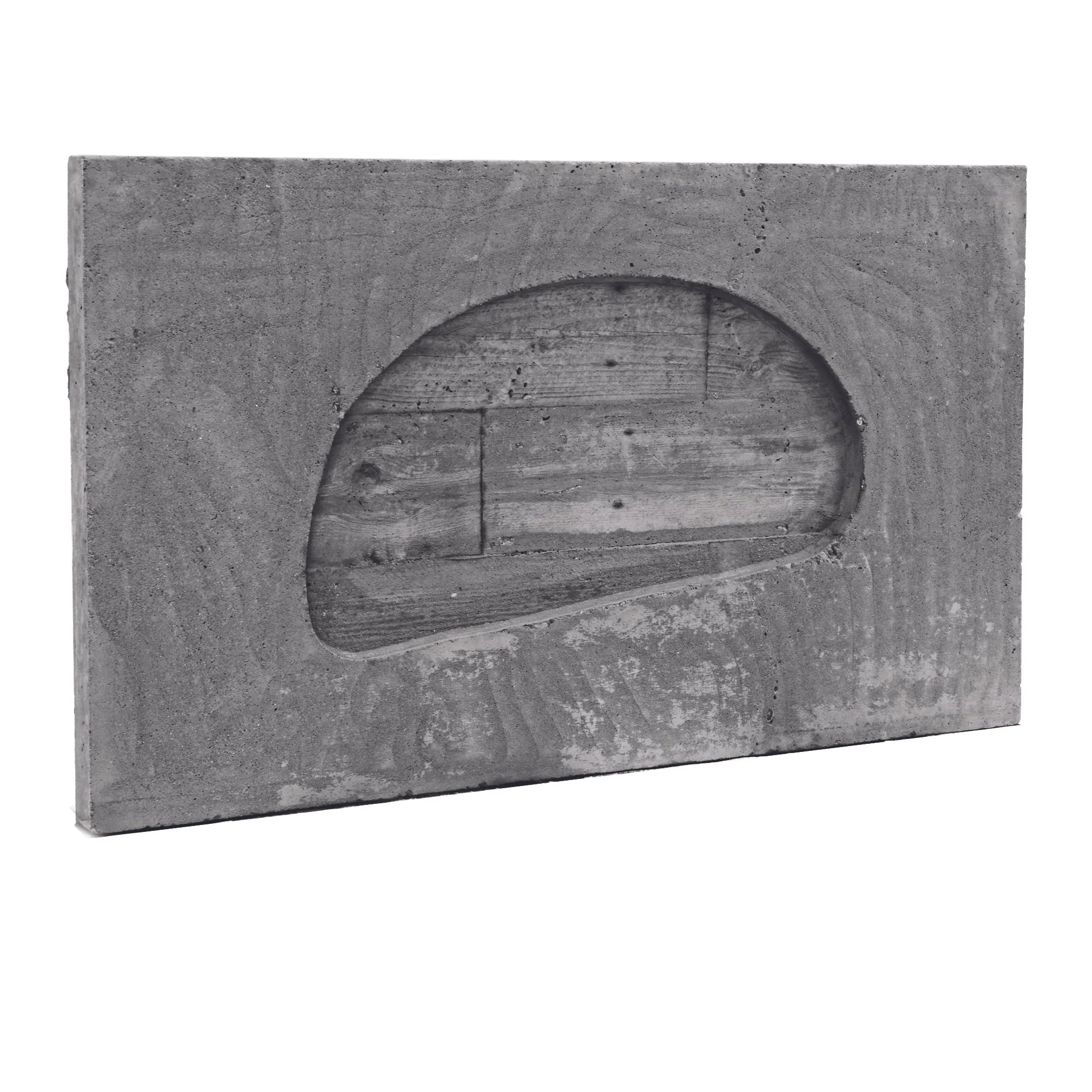
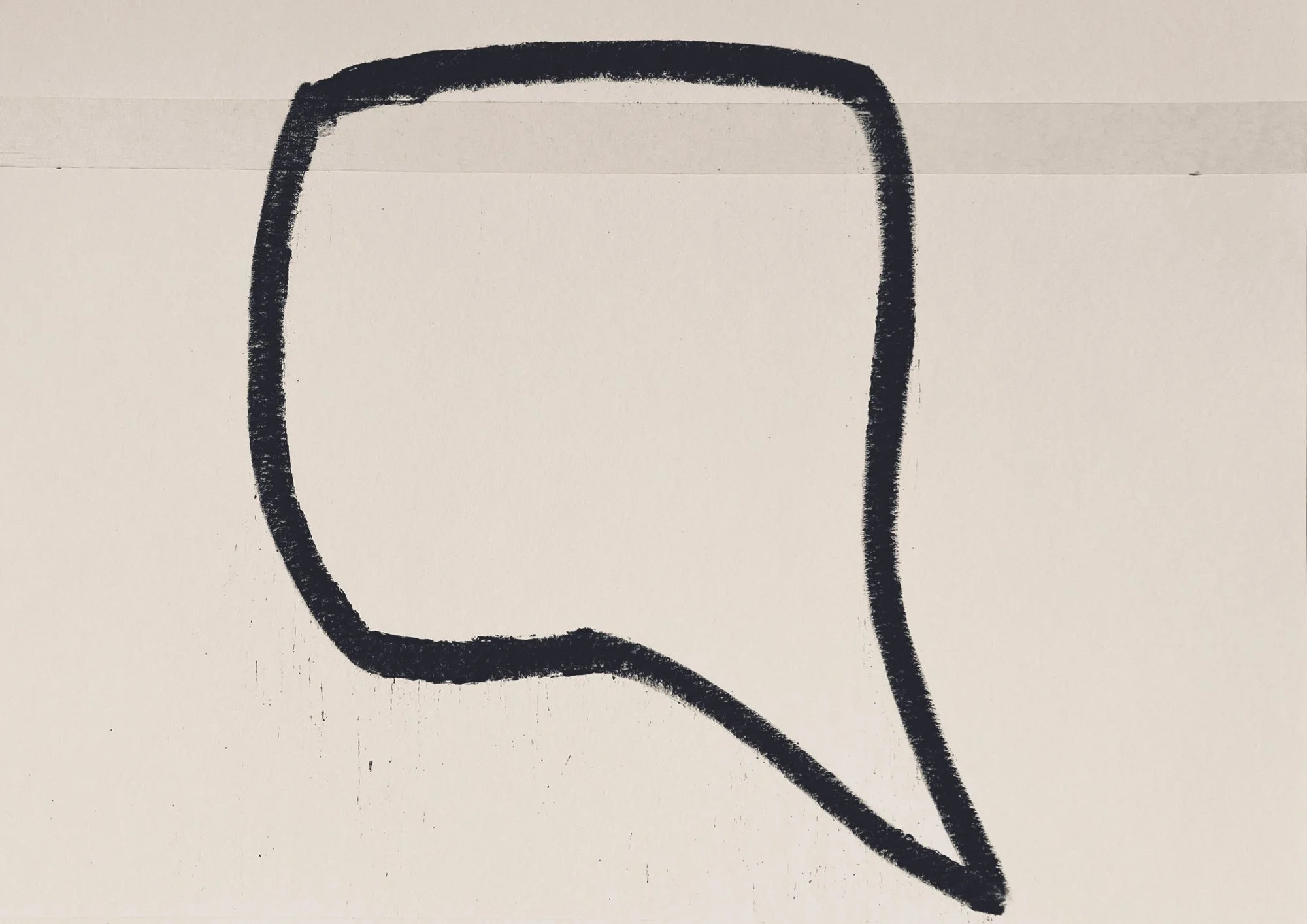
title: deposition QW7M+26M Alcaide / medium: cast concrete / dimensions: 1000mm x 700mm
Deposition: an installation that is infrastructural, indexical and territorial. It does not transform the landscape into sculptural volume; it marks, records and stabilises a hydrological condition within the landscape itself. It is a permanent installation sited at the keypoint of the cañada y boquera — the precise point where the force of water movement changes from erosive to depositional, where the upper catchment meets the growing zone below. It will consists of one hundred bas-relief béton brut tablets, each one thousand by four hundred millimetres, mounted at the keypoint and defining horizontal space within the water catchment system. Each tablet is a record — a spatial and temporal delineation of the landform, a database for ecological regeneration, a mark made at the exact point where the system's logic is most concentrated. The installation is a work in progress, developing in parallel with the restoration of the system itself.
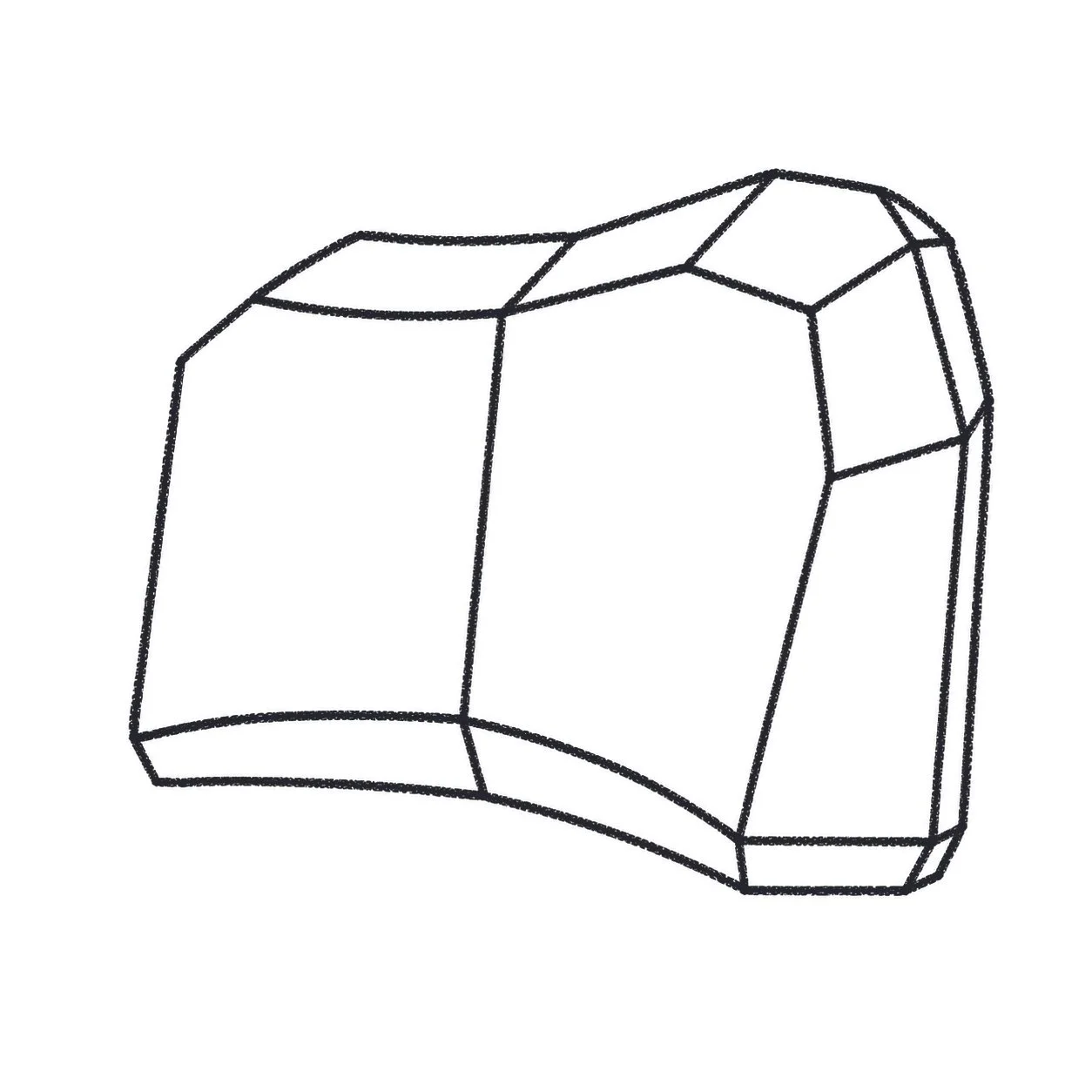
Clay Works: transformational and phenomenological sculptures that convert planimetric spatial information into embodied volume through gravity, orientation and material negotiation. The sculptures originate from the plan-based field drawings made within the cañada y boquera — spatial notations derived from movement, edge conditions and bodily navigation through the landscape. Rather than translating these drawings into elevation or representation, the work treats the plan itself as a generative spatial armature, using the drawn contour as a sectional generator for volumetric clay form. Produced using marl clay sourced directly from the site itself, the forms are rotated vertically and become subject to gravity, balance, weight and material behaviour, resulting in structures shaped as much by physical negotiation as by the originating field trace.
Underlying the work is the proposition that form emerges neither from authorship nor material alone, but through the resistant encounter between body, matter and terrain — where intention meets what will not yield. In this sense, the sculptures are not representations of landscape, but phenomenological spatial encounters produced through a transformation from cartographic space into gravitational space: forms determined by these hands, this earth, and the physical conditions acting upon them.
Simon Beckmann
Simon Beckmann is an artist living and working permanently at Cortijada Los Gázquez in the Parque Natural Sierra María–Los Vélez, Almería. His practice moves between painting, drawing, and installation, with a sustained focus on the landscapes, ecologies, and hydrological systems of the Mediterranean steppe in which he lives. He is the founder of Joya: arte + ecología / AiR, an artist residency programme embedded in this landscape, which has hosted artists and researchers from across the world since 2009.
Glossary:
KöppenGeiger — a widely used system for categorising the world's climates based on temperature, precipitation and seasonal patterns. Developed originally by German-Russian climatologist Wladimir Köppen in the late 19th century and later refined by Rudolf Geiger, it divides the world into five main climate zones — tropical, arid, temperate, continental and polar — each subdivided into more specific types. It is commonly used in geography, ecology and agriculture to describe and map regional climates.
Mediterranean steppe — an arid, open landscape of sparse grasses and low shrubs adapted to hot dry summers and cold winters, receiving insufficient rainfall to support forest but too much to become desert.
Chaparral — a dense, drought-resistant scrubland of hard-leaved shrubs and small trees, adapted to seasonal aridity and periodic fire.
Sclerophyllous vegetation — plants with small, hard, waxy leaves evolved to minimise water loss in hot, dry climates. The leaf is the plant's answer to scarcity.
Maquis — a dense, tangled scrubland of tall woody shrubs and low trees that colonises land once cleared for agriculture or forest and subsequently abandoned. In the Mediterranean basin it typically comprises a mixture of cistus, rosemary, lavender, kermes oak, and other drought-resistant species. It is the landscape of agricultural retreat — what the land returns to when the human pressure that shaped it is removed.
Cordero segureño — a breed of sheep native to the Segura mountain range of southeastern Spain, adapted to the sparse grazing of semi-arid terrain.
Hydrological cycle — the continuous movement of water through the earth's systems: evaporating from oceans and surfaces, rising as vapour, condensing into cloud, falling as rain or snow, flowing across and into the ground, and returning eventually to the sea. It is not a resource but a process — water is never created or destroyed, only moved. The cañada y boquera is an interruption of that process: a point where human intelligence intercepts the cycle and puts it to work before releasing it back.
Cañada — the upper zone of the water catchment system: the erosional section of the mountain gully where earth terraces slow and hold rainwater, allowing it to sink into the ground and form an underground aquifer that migrates downslope under gravity toward the embalse. More broadly, the Spanish term refers to a narrow valley, gully or watercourse between hills.
Boquera — the lower zone of the water catchment system: the growing zone below the embalse, where water is distributed across the terraces via a network of acequias and sluice gates. More broadly, the Spanish term refers to the mouth or outlet of an irrigation channel — the point where water is released onto the land.
Barranco — a deep, steep-sided ravine or gully carved by water erosion, typically dry except during or after rainfall. In this system, the term refers to what the mountain gully would have become had it been left unaltered — a natural tributary feeding the broader rambla.
Rambla — a broad, dry riverbed or watercourse that remains dry for most of the year but carries fast-moving water during and after heavy rainfall. A characteristic feature of arid and semi-arid landscapes in southeastern Spain, fed by barrancos draining the surrounding mountains.
Embalse — a water storage tank or reservoir. In this system, the embalse was built at the point where the upper cañada meets the lower boquera, capturing the accumulated water from the underground aquifer and holding it for distribution across the growing zone via the acequias.
Acequias — an irrigation channel cut to contour, moving water across terrain by gravity alone.
Foggara — an ancient system of underground channels used to extract and transport water from a subterranean aquifer across arid terrain, found across the Saharan regions of Algeria and the wider North African desert. The foggara works entirely by gravity, tapping into the water table at a higher elevation and conducting it through a gently sloping tunnel — sometimes kilometres long — to the point of use. Like the cañada y boquera, it is a system that reads the ground rather than imposing upon it: a form of hydraulic intelligence arrived at incrementally, without drawings, under the fixed constraints of an arid climate and a resistant earth.
Mampostería — traditional rubble masonry: walls built from irregular stones laid without precise cutting or coursing, bound in lime and sand mortar. The form of the wall is determined by the form of the available stone. It is the most direct translation of the immediate ground into built structure — the site becoming its own building material, the geology of the place made vertical.
Maquette — a small-scale three-dimensional model, typically in plaster, clay, or other malleable material, used by sculptors and architects to work out form before committing to full scale. In the case of Casa El Laberinto, the maquette — titled Habitación, Carboneras, España and now in the collection of the Musée National d'Art Moderne at the Centre Georges Pompidou in Paris — was not a preliminary study but the primary document from which the building was constructed. There were no architectural drawings. The builders worked from the model directly, translating its surfaces into stone and lime mortar at full scale under Claude Parent's on-site supervision. The maquette is therefore not a representation of the building. It is its origin — the moment at which a sculptor's working method became, without ceremony, an architectural one.
Lucernarios — skylights cut directly into the roof surface of Casa El Laberinto, functioning as the building's primary source of natural light. In the absence of conventional windows — openings in walls that connect interior to exterior — light enters from above, falling vertically into the vaulted rooms below. The effect is closer to a cave lit by an opening in the rock than to any conventional room. The lucernario does not frame a view. It admits light as a substance, without context.
Habitacle — a term chosen by André Bloc to describe the sculptural environments he began developing in the early 1960s: spaces conceived as neither sculpture nor architecture but occupying the charged ground between the two. The word is archaic French for a dwelling place — a space not merely looked at but entered and inhabited bodily. The habitacles were built in concrete and reinforced polyester, with continuous curved surfaces in which walls flow into ceilings without conventional junction, thresholds shaped as flowing voids, interiors lit from above. They are cave-like, organic, continuous — the point at which Bloc's suppressed conditional logic became fully explicit, and the cave-like interior that Casa El Laberinto had circled around became the entire proposition.
Homme de synthèse — a man of synthesis. Someone whose purpose — intellectual and practical — is to bring together what the disciplines insist on keeping apart. It was a term with genuine cultural weight in mid-century French intellectual life, describing a particular type of figure who moved across boundaries not out of dilettantism but out of a philosophical conviction that the boundaries themselves were the problem.
Labrador de tierra — one who works the earth directly, with his hands and his body.
Casbah / Kasbah — a fortified citadel or the dense residential quarter surrounding it, found throughout the cities of the Maghreb. Form accumulated over centuries without drawings or authorial intention — streets following the fall of the ground, interiors vaulted and continuous, surfaces whitewashed against heat and light. Not designed. Grown.
Ksar / Ksour — a fortified communal settlement of the pre-Saharan and Saharan Maghreb, built from rammed earth, mudbrick, and rough stone. The ksar is not a single building but an entire community contained within a defensive envelope — houses, granaries, mosques, and passages organised around shared walls and collective necessity. The plural is ksour.
Al-Andalus — the territories of the Iberian peninsula under Moorish rule from the eighth to the fifteenth century. At its greatest extent it encompassed most of present-day Spain and Portugal. Almería was one of its principal ports — a point of continuous exchange between the peninsula and North Africa, sharing builders, materials, and the architectural logic of the arid Mediterranean. The forms that accumulated here under eight centuries of Moorish building were not imported. They were generated by the same conditions, on the same ground, under the same climate, as those that built the cities of the Maghreb across the water.
Indalo — a prehistoric figure painted in red ochre on the wall of the Cueva de los Letreros at Vélez Blanco, in the sierra above the cañada y boquera, between four and a half and six and a half thousand years ago. A schematic human form with arms extended, holding an arc — interpreted variously as a rainbow, a bow, or the celestial vault. Retrieved from obscurity by Jesús de Perceval in 1943 and adopted as the emblem of the Movimiento Indaliano, it became the symbol of a cultural identity rooted in the deep prehistory of the Almerian landscape. It is painted still on the doors of houses in the north of the province as protection against storms and the evil eye.
Publication
QW7M+26M / X3JW+RR was first produced as an artist’s publication for Agor Llyfr / Open Book, Capel Bethel, Cwmrheidol, Wales.
© Simon Beckmann, 2026.